
The Maya Forest and Marine Corridors: Connecting Mountains to Sea in Belize
The Maya Forest Corridor is a conservation initiative in Belize to protect and restore critical ecosystems and promote biodiversity. The Maya Mountain Marine Corridor is an initiative that combines conservation efforts beyond the traditional boundaries of terrestrial and marine ecosystems.
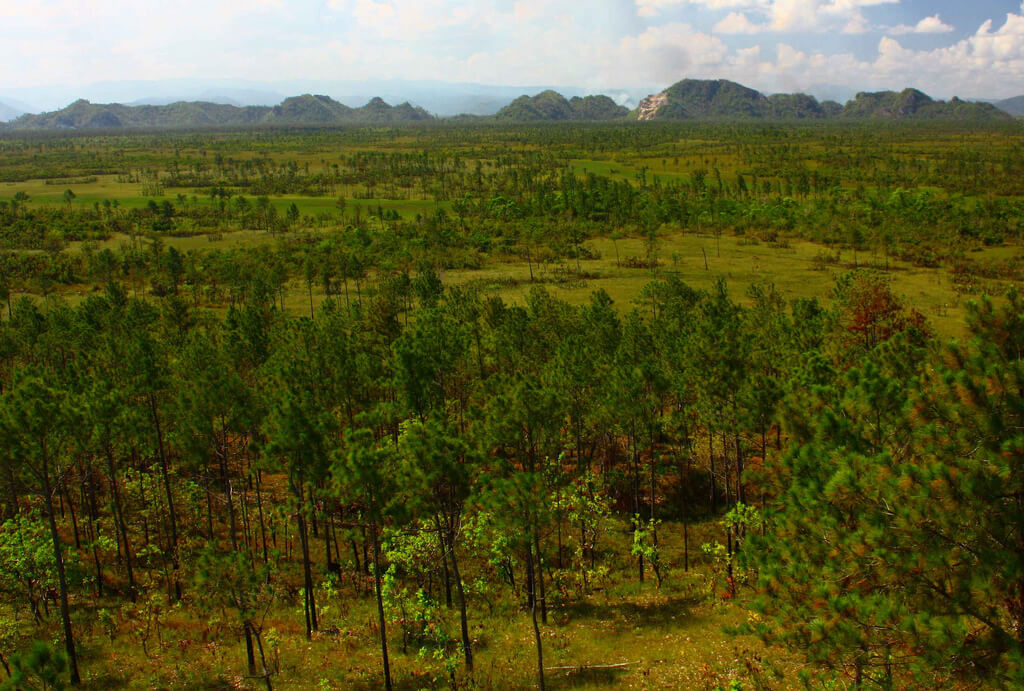
From Maya Mountains to Caribbean Reefs: The Story of Belize's Conservation Corridors
Extending over 400,000 hectares (1 million acres) from southwestern Belize's Maya Mountains eastward to the Caribbean Sea, the Maya Mountain Marine Corridor represents one of the world's most innovative conservation approaches—integrating terrestrial and marine ecosystem management to create a continuous protected landscape from mountain peaks to coral reefs. This visionary corridor bridges the gap between highland forests and coastal waters, where species rely on both terrestrial and marine habitats during their life cycles. Simultaneously, the Maya Forest Corridor to the north connects the Maya Mountains with the vast Selva Maya spanning Guatemala, Mexico, and Belize—the largest remaining forest in the Mesoamerica Biodiversity Hotspot. These interconnected corridors face an urgent conservation crisis, with the narrow forest thread linking north and south reduced by over 65% in the past decade at deforestation rates four times Belize's national average, threatening to fragment one of the last great forests on Earth and isolate wildlife populations that require vast, connected landscapes for long-term survival.
The Maya Mountain Marine Corridor: Land Meets Sea
The Maya Mountain Marine Corridor (MMMC) exemplifies integrated ecosystem management by recognizing that conservation must address the interconnections between terrestrial and aquatic systems. This corridor encompasses a remarkable diversity of habitats, including tropical rainforests covering the Maya Mountain slopes, coastal wetlands and mangroves, seagrass beds in shallow marine waters, and coral reefs along the Belize Barrier Reef—the second-longest barrier reef system on Earth.
Many species depend on multiple habitat types during their life cycles. Sea turtles nest on beaches but feed in seagrass beds and around coral reefs. Manatees (Trichechus manatus) move between coastal mangroves and inland rivers. Fish spawn in mangrove nurseries before migrating to reef environments. Birds forage in coastal wetlands while nesting in inland forests.
Freshwater and nutrient flows from the mountains profoundly influence marine ecosystems. Rivers draining the Maya Mountains carry freshwater, sediments, and nutrients to coastal zones, while mangrove forests filter terrestrial runoff before it reaches coral reefs, protecting these sensitive ecosystems from excessive sedimentation and pollution.
The corridor's protected areas work synergistically: Bladen Nature Reserve (39,650 hectares/98,000 acres) preserves pristine highland watersheds; Cockscomb Basin Wildlife Sanctuary (400 square kilometers/150 square miles) protects mid-elevation forests; Payne's Creek National Park safeguards coastal wetlands and mangroves; Port Honduras Marine Reserve (40,499 hectares/100,069 acres) protects seagrass beds and coral reefs; and Sapodilla Cayes Marine Reserve (47,702 hectares/117,878 acres) conserves offshore reef and atoll ecosystems.
The Maya Forest Corridor: Preventing Fragmentation
The Maya Forest Corridor addresses a different but equally critical conservation challenge—maintaining connectivity between the Maya Mountain Massif in southwestern Belize and the Selva Maya to the north. This narrow corridor, now just 8-10 kilometers (5-6 miles) wide in places, is the only forest connection preventing permanent fragmentation of the Maya Forest.
The corridor's importance for wide-ranging species is critical. Jaguars require vast territories—male home ranges can exceed 100 square kilometers (40 square miles). The corridor connects Belize's two Jaguar Conservation Units: the Maya Mountain Massif and the rest of the Selva Maya, which extends into Guatemala and Mexico. Without this connection, jaguar populations would become isolated, reducing genetic diversity and long-term viability.
White-lipped peccaries (Tayassu pecari), highly social ungulates that travel in herds sometimes numbering hundreds, require large, continuous forests for seasonal movements. Baird's tapir (Tapirus bairdii), Central America's largest land mammal, also depends on extensive forest connectivity. Central American spider monkeys (Ateles geoffroyi) and Yucatán black howler monkeys (Alouatta pigra) require a continuous canopy for movement between forest patches.
Research by the University of Belize Environmental Research Institute and Panthera, beginning in 2005, identified the Maya Forest Corridor as critical to maintaining 60% of Belize's forests' connectivity to the Five Great Forests of Mesoamerica. Camera-trap studies confirmed that the corridor remains functional and is actively used by jaguars, pumas, tapirs, peccaries, and numerous other species.
The Deforestation Crisis
Despite its critical importance, the Maya Forest Corridor has suffered catastrophic habitat loss. Between 2011 and 2021, over 65% of the corridor's forest was destroyed, shrinking from approximately 80,000 acres to less than 30,000 acres. The deforestation rate is 4 times Belize's national average, driven primarily by clearing land for industrial-scale sugarcane cultivation and large-scale farming.
This rapid forest loss threatens to sever the last connection between northern and southern forests. If the corridor is lost entirely, the consequences would be severe: genetic isolation of wildlife populations, reduced species viability, disrupted migration patterns, and permanent fragmentation of one of the world's most important tropical forest ecosystems.
A 2023 study found that reforestation in the Maya Mountains and connecting corridors could significantly enhance carbon storage and biodiversity recovery over the next two decades, underscoring the importance of restoration alongside protection.
Conservation Response and Land Acquisition
Recognizing the corridor's critical importance and the imminent threat it faces, the Maya Forest Corridor Coalition—comprising Re:wild, Belize Maya Forest Corridor Trust, Panthera, The Nature Conservancy, Programme for Belize, and other partners—has worked since 2011 to secure permanent protection.
In 2021, the coalition achieved a major milestone by purchasing 12,000 hectares (30,000 acres)—the single largest property within the corridor and the parcel most urgently under threat. This acquisition, supported by the Wyss Foundation and other donors, secured approximately one-third of the minimum 20,000 hectares (50,000 acres) identified as necessary to maintain corridor function.
Private landowners, the Belize Zoo, Monkey Bay Wildlife Sanctuary, and the Foundation for Wildlife Conservation protect an additional 4,000 hectares (10,000 acres). The coalition continues to work to conserve the remaining identified priority areas through purchase, conservation easements, and other protection mechanisms.
The Greater Belize Maya Forest
North of the corridor, the Belize Maya Forest and Rio Bravo Conservation and Management Area together form the Greater Belize Maya Forest—over 211,000 hectares (521,000 acres) of savanna, wetlands, and tropical rainforest representing nearly 10% of Belize's total land area.
The biodiversity is astonishing: 200 tree species, 390 bird species, and 80 mammal species, including one of the world's healthiest jaguar populations. The Yucatán black howler monkey, Geoffroy's spider monkey, Baird's tapir, white-lipped peccary, and all five Central American cat species thrive in these forests.
The Belize Maya Forest Trust, established in 2020, manages 110,000 hectares (272,000 acres) of former Yalbac and Laguna Seca lands following the biosphere reserve principle—a strictly preserved core area surrounded by buffer zones used for sustainable development activities that generate revenue for protection while maintaining biodiversity.
Programme for Belize manages the adjacent Rio Bravo Conservation and Management Area (102,790 hectares/254,000 acres), the country's largest private reserve. Together, these conservation areas create a vast protected landscape that, when connected through the Maya Forest Corridor to the Maya Mountain Massif, forms one of Central America's most significant conservation achievements.
Conservation Management and Challenges
Protecting these vast forest areas requires substantial resources and sustained effort. Principal threats include illegal logging, illegal hunting, agricultural encroachment, wildfires during dry seasons, and illegal crop cultivation.
The Belize Maya Forest Trust has significantly increased ranger presence and patrol capacity. Between 2022-2023 and 2023-2024, active patrols more than doubled from 158 to 320, using smart patrol technology to document threats and monitor wildlife. Rangers conduct both day and night patrols using camera traps, GPS tracking, and communication systems to enhance surveillance efficiency.
Goals by 2027 include preventing wildfires, maintaining stable predator-prey populations, restoring forest health and connectivity, reducing invasive species, tackling pollution in cenotes and waterways, and strengthening community engagement programs.
Community Engagement and Sustainable Development
Conservation success requires working with communities whose livelihoods depend on natural resources. Conservation organizations are facilitating sustainable alternatives—regenerative agriculture to replace slash-and-burn methods, sustainable forestry and non-timber forest products, and ecotourism opportunities that create economic incentives for conservation.
Hannah St. Luce-Martinez, director of Belize's National Biodiversity Office, emphasizes that "protected areas management comes with a cost—a cost which competes with other national and global social and economic needs. Beyond protection of priority ecosystems, there must also be an emphasis on improving land practices on private lands with a focus on environmental, social, and economic sustainability."
The Path Forward
The Maya Forest and Marine Corridors represent a bold conservation vision translated into action. The Maya Mountain Marine Corridor demonstrates that effective conservation must address interconnections between land and sea. The Maya Forest Corridor exemplifies the critical importance of connectivity for wide-ranging species and the urgent need to prevent fragmentation.
Recent achievements—including the 2021 acquisition of 12,000 hectares within the Maya Forest Corridor, the 2020 establishment of the Belize Maya Forest Trust protecting 110,000 hectares, and expanded ranger programs—demonstrate that large-scale conservation is achievable.
However, the urgency cannot be overstated. The Maya Forest Corridor continues shrinking, with deforestation rates four times the national average threatening to sever the connection within years without aggressive intervention. The remaining unprotected portions must be secured quickly to maintain functionality.
For Belize—a nation that has protected nearly 40% of its land area—the Maya Forest and Marine Corridors represent both a conservation success story and an ongoing challenge requiring sustained commitment. These corridors ensure that jaguars can roam from mountain forests to coastal lowlands, that rivers flowing from the Maya Mountains nourish coral reefs, and that one of the world's great tropical forest ecosystems remains connected from Mexico to Belize's southern border, safeguarding biodiversity and ecosystem services for future generations.
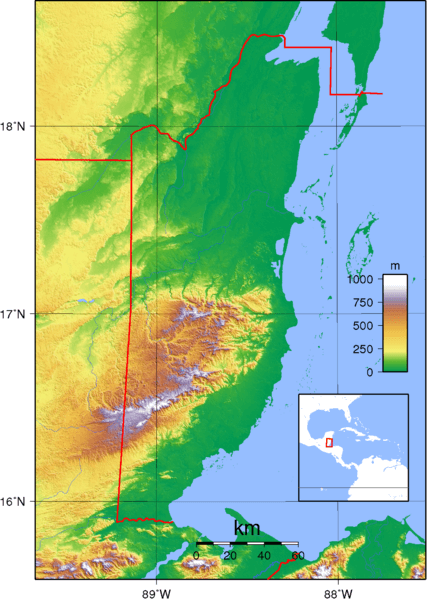
Topography map of Belize depicting the Maya Mountains and Cockscomb Range.