
The Lesser Antilles: Arc of Islands Between Two Oceans
Nestled in the heart of the Caribbean Sea, the Lesser Antilles form an island chain that stretches between the Greater Antilles and South America. Comprising a mix of volcanic and non-volcanic islands, the archipelago boasts stunning landscapes, rich cultural heritage, and unique ecosystems.
The Lesser Antilles: Geology, Biodiversity, and Cultural Crossroads of the Eastern Caribbean
The Lesser Antilles form a curving chain of islands that stretches approximately 850 km (530 mi) from the Virgin Islands in the north to Trinidad and Tobago near the coast of Venezuela in the south. Separating the Caribbean Sea from the Atlantic Ocean, these islands mark the eastern boundary of the Caribbean basin and encompass a remarkable range of geological ages, ecological types, and cultural traditions within a relatively compact arc.
The archipelago is conventionally divided into four groups: the Leeward Islands in the north, the Windward Islands in the south-central arc, the continental outlier of Trinidad and Tobago at the southern terminus, and the Leeward Antilles (or ABC islands) to the southwest near the Venezuelan coast. Together they represent some of the Caribbean's most distinctive landscapes — from the still-active volcanic summits of Dominica and Montserrat to the near-flat coral limestone platforms of Anguilla and Barbuda, from the arid cacti-studded hills of Aruba to the mist-draped rainforests of St. Vincent, and from the mangrove swamps of Trinidad's Caroni Basin, a fragment of the South American mainland rather than the volcanic arc proper.
Geological Setting
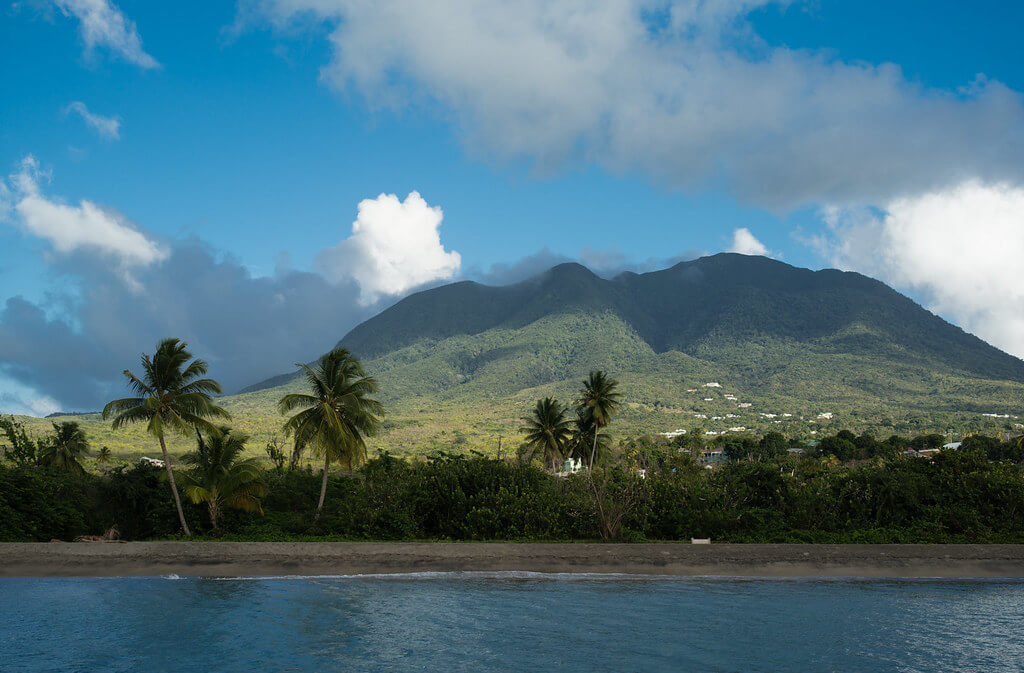
The Lesser Antilles owe their existence to the subduction of the North American Plate (and, at the southern end, the South American Plate) beneath the Caribbean Plate, converging at a rate of roughly 2 cm (0.8 in) per year — a slow but relentless collision that has generated a chain of volcanic islands along the inner arc of the archipelago over the last 40 million years. These younger volcanic islands — including Dominica, St. Vincent, Grenada, Martinique, and St. Kitts — are characterized by steep terrain, fertile volcanic soils, dense rainforest, and ongoing geothermal activity. Dominica, in particular, is so young and geologically active that it has no less than nine active volcanic centers, boiling lakes, and fumarole fields, earning it the sobriquet the 'Nature Island' of the Caribbean. Saint Vincent's La Soufrière last erupted explosively in April 2021, displacing roughly 20,000 residents and depositing ash across the eastern Caribbean as far as Barbados.
The outer arc of the Lesser Antilles, by contrast, consists of older, eroded volcanic islands and coral limestone platforms, remnants of an earlier phase of arc volcanism that has since been buried under carbonate accumulation. Islands such as Anguilla, Barbuda, and the eastern portions of Guadeloupe (Grande-Terre) are low-lying and composed largely of carbonate rock, giving them flat or gently rolling topography, brilliant white sand beaches, and extensive barrier reefs. The Leeward Antilles — Aruba, Bonaire, and Curaçao — are continental shelf fragments with no volcanic origin, quite unlike the rest of the chain. This distinction gives them their characteristic arid climate and striking contrast of desert scrub and turquoise sea.
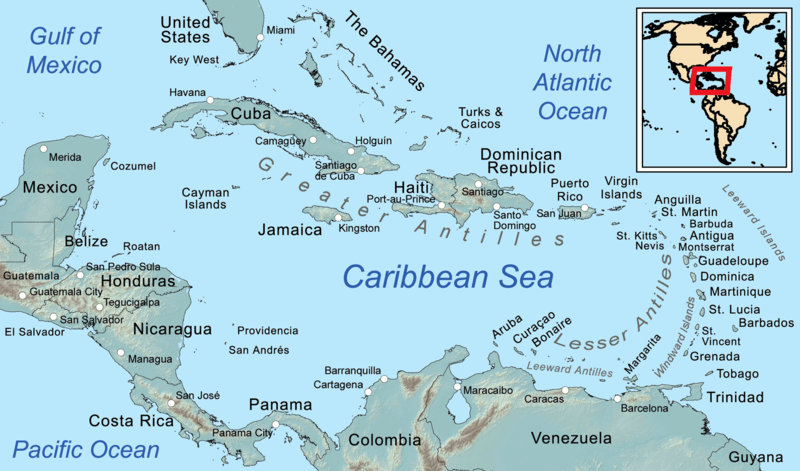
Map depicting the island groups of the Caribbean region: the Lesser Antilles are shown in the southeast.
The Leeward Islands
The Leeward Islands occupy the northern portion of the Lesser Antilles chain, running southeast from the Virgin Islands to Guadeloupe. The name derives from their position relative to the prevailing northeasterly trade winds: they lie in the partial shelter, or lee, of the wind relative to Caribbean sea lanes — though in practice the distinction from the Windward Islands to their south is more historical and conventional than strictly meteorological.
This group encompasses an extraordinary degree of political and cultural diversity within a small geographic space. The Virgin Islands are divided between the United States (St. Thomas, St. John, St. Croix, and Water Island) and the United Kingdom (Tortola, Virgin Gorda, Anegada, Jost Van Dyke, and approximately 56 smaller cays). To their south, Anguilla remains a British Overseas Territory, while nearby Sint Maarten/Saint-Martin is shared between the Netherlands and France — the only land border between these two nations anywhere in the world, famously unguarded and maintained by a 1648 treaty. Saint Barthélemy, with its French sophistication and exclusive resorts, lies close to the Dutch/French island of Sint Eustatius (Statia), a tiny island with an outsized 18th-century history as the trading hub of the Atlantic world.
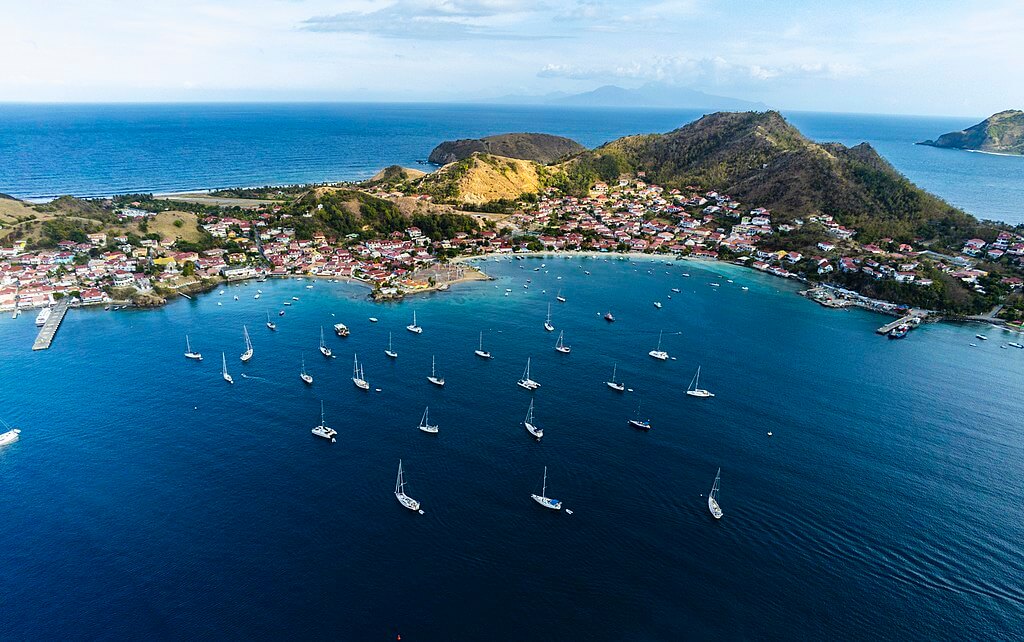
Further south, Saint Kitts and Nevis form a federated independent nation with a combined population of roughly 47,000, while Antigua and Barbuda — also independent — are renowned for Antigua's 365 beaches and Barbuda's Codrington Lagoon, home to the largest frigatebird (Fregata magnificens) colony in the Caribbean, estimated at 5,000 or more nesting pairs. Montserrat, a British Overseas Territory, is defined by the still-active Soufrière Hills volcano, whose 1995 eruption buried the former capital, Plymouth, under meters of pyroclastic debris and ash, rendering the southern two-thirds of the island a permanently exclusion zone. Guadeloupe, administratively an overseas region of France, is itself an archipelago, its two main islands — Basse-Terre (volcanic and mountainous) and Grande-Terre (low limestone plateau) — separated by a mangrove-lined channel called the Rivière Salée. La Soufrière on Basse-Terre, at 1,467 m (4,813 ft), is the highest point in the Lesser Antilles.
The Windward Islands
South of Dominica, the Windward Islands take their name from their more exposed position to the Atlantic trade winds, which historically made these coasts harder to approach and defend. This group extends from Dominica through Martinique, Saint Lucia, Saint Vincent and the Grenadines, and Grenada, with Barbados lying somewhat to the east as an outlier on the Atlantic side of the chain.
The Windward Islands are characterized by dramatic volcanic landscapes, lush forests, and a cultural heritage that reflects intense French and British colonial rivalry. Martinique and Guadeloupe remain French overseas regions, their roughly 350,000 and 380,000 residents respectively holding full French citizenship, their currency the euro, and their administrative ties to Paris closer than to any neighboring Caribbean state. In 1902, the eruption of Mount Pelée on Martinique killed an estimated 30,000 people — virtually the entire population of the colonial capital Saint-Pierre — in one of the deadliest volcanic events in recorded history.
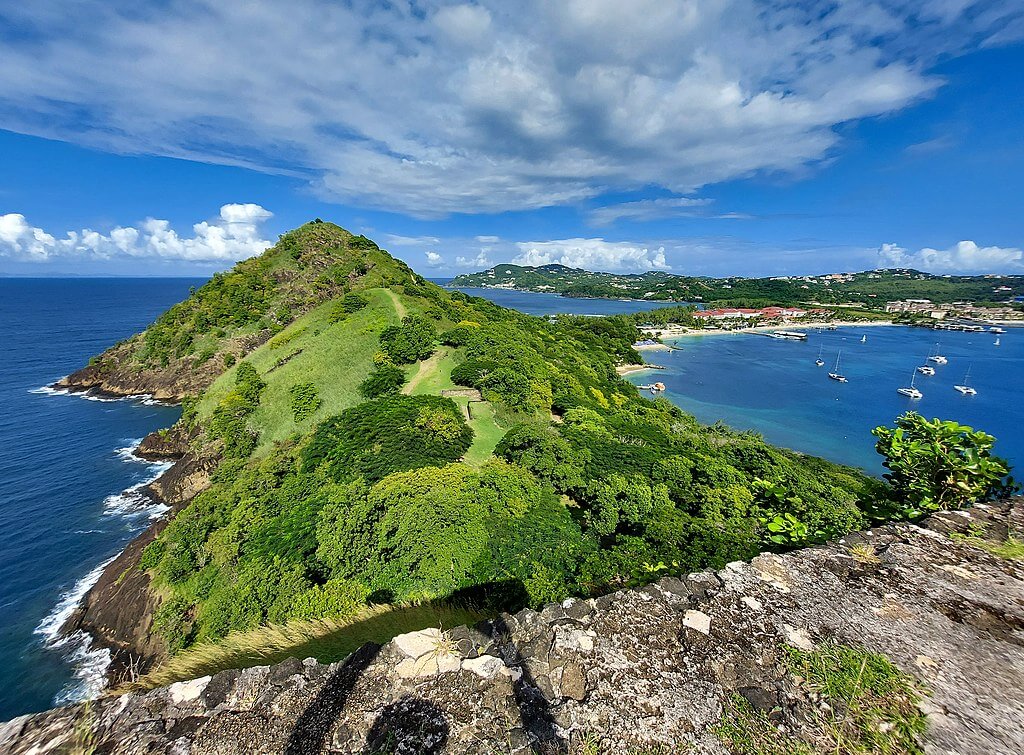
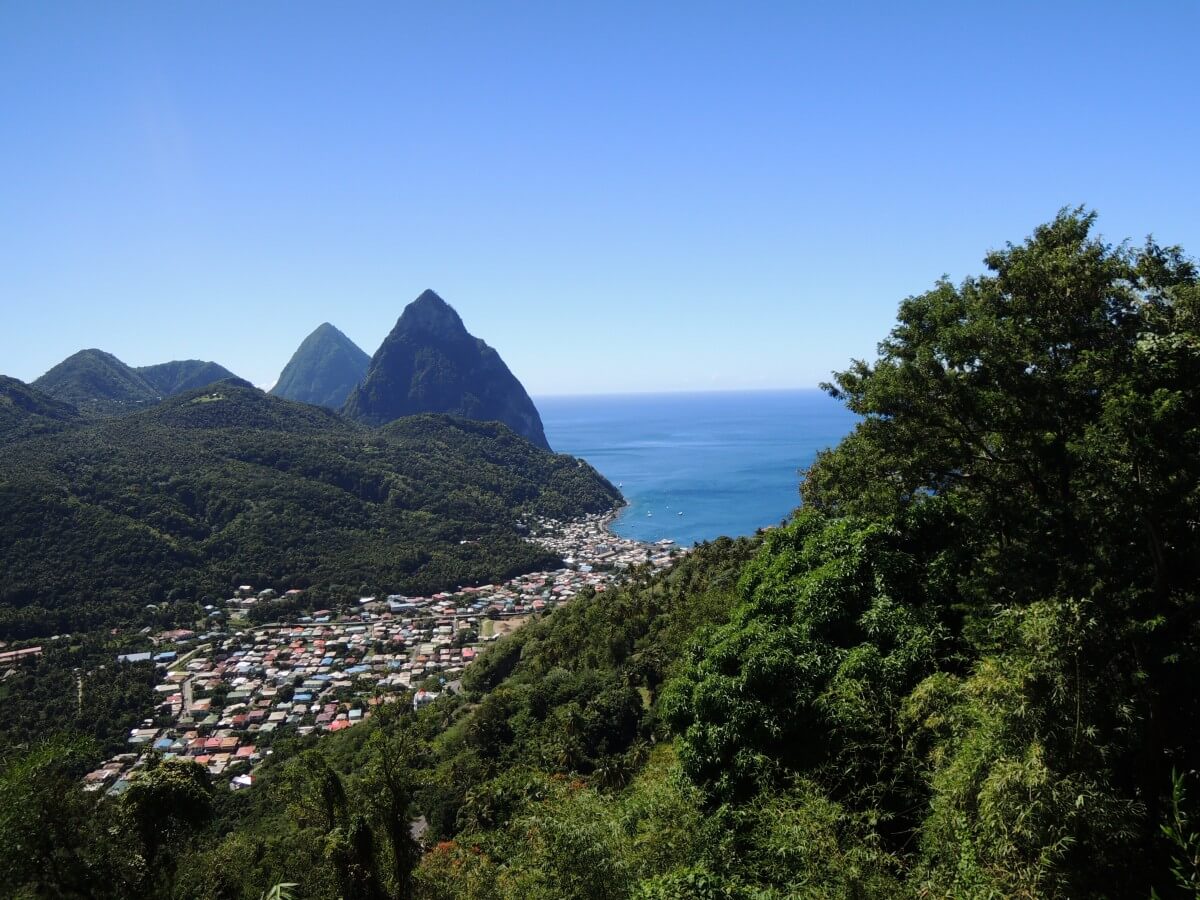
Saint Lucia changed hands between Britain and France no fewer than fourteen times before finally becoming British in 1814, and this colonial tug-of-war left the island with a French Creole language and culture alongside English law and government. Its twin volcanic plugs, Gros Piton (770 m / 2,526 ft) and Petit Piton (743 m / 2,438 ft), are among the most dramatic landforms in the Caribbean and form part of a UNESCO World Heritage Site. Grenada, the 'Spice Isle,' produces roughly 20% of the world's nutmeg (Myristica fragrans) and is also significant for its mace, cloves, and cinnamon; the island's spice economy has never fully recovered from Hurricane Ivan's destruction of the nutmeg groves in 2004, though replanting continues. Saint Vincent and the Grenadines extends south through a 90 km (56 mi) chain of 32 islands and cays, the most celebrated of which — Mustique and the Tobago Cays — are world-renowned for their beaches and sailing waters. Barbados, a coral limestone island rather than a volcanic one despite its Windward grouping, became a republic in 2021, removing the British monarch as head of state after more than three centuries of continuous British rule dating to 1625.
Trinidad and Tobago: A Continental Outlier
At the southernmost tip of the Lesser Antilles chain, barely 11 km (7 mi) from the Venezuelan coast at their closest point, Trinidad and Tobago stand apart geologically from every other island in the archipelago. Rather than being products of the volcanic arc, they are fragments of the South American continental shelf, severed from the mainland by rising sea levels at the end of the last glacial period roughly 11,000 years ago. Trinidad's Northern Range is a direct geological extension of Venezuela's Cordillera de la Costa. The island's flora and fauna reflect this mainland ancestry far more than they resemble the endemic-rich volcanic islands to the north: Trinidad hosts jaguars (Panthera onca), ocelots (Leopardus pardalis), and more than 470 recorded bird species, an assemblage far richer than any comparably sized volcanic island in the chain.
The twin-island nation, independent since 1962 and a republic since 1976, is anchored economically by petroleum and natural gas rather than tourism — Trinidad's Pitch Lake at La Brea is the largest naturally occurring deposit of asphalt in the world, and has been mined continuously since the 19th century. The Caroni Swamp, a mangrove wetland near Port of Spain, is the principal roosting site of the scarlet ibis (Eudocimus ruber), Trinidad and Tobago's national bird, whose evening return in flocks of brilliant red is among the most photographed wildlife spectacles in the Caribbean. Tobago, smaller and more tourism-oriented than its sister island, is fringed by some of the oldest protected rainforest in the Western Hemisphere, the Main Ridge Forest Reserve, established in 1776.
The Leeward Antilles
Aruba, Bonaire, and Curaçao — the ABC islands, often called the Leeward Antilles or Dutch Caribbean — lie less than 100 km (62 mi) from the Venezuelan coast and outside the hurricane belt, a geographical position that distinguishes them sharply from the rest of the Lesser Antilles. All three are autonomous territories within the Kingdom of the Netherlands, though their political structures differ: Aruba and Curaçao have 'constituent country' status with significant self-governance, while Bonaire is a special municipality of the Netherlands with direct Dutch oversight.
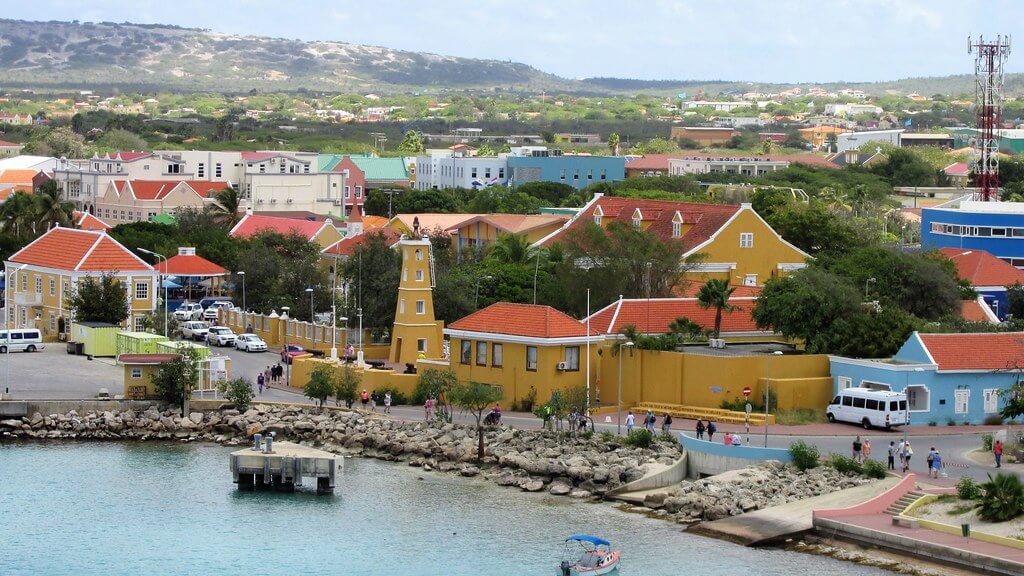
The ABC islands' climate is semi-arid, shaped by the rain shadow of the Venezuelan Andes, and their vegetation consists largely of xerophytic scrub dominated by the endemic kadushi cactus (Cereus repandus) and the divi-divi tree (Caesalpinia coriaria), which grows at a characteristic windward-leaning angle due to the persistent trade winds. Bonaire's coral reefs are among the most pristine in the Caribbean, protected by the Bonaire National Marine Park, and the island's commitment to reef conservation has made it one of the world's premier scuba diving destinations. Aruba's south coast features the Pink Beach, named for the crushed coral that tints its sands, while Curaçao's capital, Willemstad, is a UNESCO World Heritage Site celebrated for its brightly painted Dutch colonial townhouses and its iconic Handelskade waterfront.
East of the ABC islands, stretching along the Venezuelan coast toward Trinidad, lies the Venezuelan portion of the Leeward Antilles: a scattered constellation of islands, archipelagos, and cays politically divided between the state of Nueva Esparta and the Federal Dependencies of Venezuela. These territories, though far less visited internationally than their Dutch counterparts, encompass some of the most ecologically intact marine environments in the Caribbean, as well as one of the region's most historically significant island groups.
Ecology and Biodiversity
The Lesser Antilles are a recognized global biodiversity hotspot, forming part of the broader Caribbean Islands hotspot identified by Conservation International. Despite their small collective land area, the islands support hundreds of endemic species, concentrated above all in the inner volcanic arc, where dense rainforests have provided long-term refugia for evolutionary diversification. The endemic Imperial amazon (Amazona imperialis) and Red-necked amazon (Amazona arausiaca), both found only on Dominica, represent two of the most endangered parrots in the world, with wild populations numbering in the low hundreds for each species. The Saint Vincent amazon (Amazona guildingii) is similarly restricted to its namesake island and is Vulnerable according to the IUCN Red List, its recovery from a low of roughly 400 individuals in the 1980s attributed largely to sustained captive-breeding and habitat-protection programs.
Marine biodiversity is exceptional throughout the chain. Coral reefs support more than 500 species of fish, hawksbill sea turtles (Eretmochelys imbricata), green turtles (Chelonia mydas), and leatherback turtles (Dermochelys coriacea) nest on beaches from Barbuda to Trinidad. The Soufrière-Scotts Head Marine Reserve in Dominica protects an underwater volcanic landscape of extraordinary richness, including black smoker vents, wall dives, and sponge gardens that attract experienced divers from around the world. In 2023, Dominica designated the world's first dedicated marine protected area for sperm whales (Physeter macrocephalus), covering roughly 800 sq km (300 sq mi) of its western coastal waters, home to a resident population estimated at around 200 individuals that use the deep waters off the island's leeward coast as a nursery ground year-round.
Cultural Heritage
The cultural landscape of the Lesser Antilles is a product of layered histories: Indigenous Arawak and Kalinago (Carib) civilizations, Spanish, French, British, Dutch, and Danish colonial rule, and the African diaspora that accompanied centuries of plantation slavery. The Kalinago people, who gave the Caribbean its name and fiercely resisted European colonization, maintain a Territory on Dominica — the only remaining pre-Columbian Indigenous community in the Lesser Antilles — where approximately 3,000 people preserve traditional weaving, boat-building, and language.
Music is perhaps the most globally resonant product of Lesser Antillean culture. Calypso and soca originated in Trinidad and Tobago and spread through the eastern Caribbean; Martinique and Guadeloupe gave the world zouk; Saint Lucia has produced acclaimed jazz artists and writers, including Nobel laureate Derek Walcott. Carnival, celebrated with particular intensity in Trinidad and Martinique, represents the fullest expression of Afro-Caribbean creative tradition — a fusion of African masquerade, French Mardi Gras, and Caribbean rhythmic invention that draws hundreds of thousands of participants annually; Trinidad's pre-Lenten Carnival alone is estimated to generate tens of millions of US dollars in economic activity each season.
The cuisine of the Lesser Antilles reflects similar complexity. Flying fish (Hirundichthys affinis) and cou-cou (cornmeal with okra) are the national dish of Barbados; roti, brought by South Asian indentured labourers who arrived after emancipation, is staple fare across Trinidad and Tobago and increasingly throughout the chain; accras de morue (salt cod fritters) are ubiquitous in the French islands; and 'oil down,' a one-pot stew of breadfruit, callaloo, and salted meat cooked in coconut milk, is the national dish of Grenada.
Economy and Tourism
Tourism dominates the economies of most Lesser Antillean islands, in several cases accounting for more than half of GDP and formal employment, a dependency that leaves these small economies acutely exposed to hurricane damage, fuel-price shocks, and shifts in North American and European travel demand. Cruise tourism in particular has grown to dwarf overnight stays on many islands: Sint Maarten and Antigua each receive well over a million cruise passengers in a typical year, a volume that strains port infrastructure and has prompted growing debate over the balance between cruise and overnight visitor revenue. The Dutch and French territories, buffered by transfer payments and administrative ties to wealthier metropoles, have weathered economic shocks somewhat more comfortably than the independent nations, several of which — Grenada, Antigua and Barbuda, and St. Kitts and Nevis among them — have turned to citizenship-by-investment programs as a supplementary revenue source, a practice that has drawn both fiscal benefit and international scrutiny. Trinidad and Tobago remains the conspicuous exception, its hydrocarbon-based economy giving it, per capita, one of the highest GDP figures in the Caribbean, though one increasingly pressured by declining natural gas output and the long-term global shift away from fossil fuels.
Conservation Challenges
The Lesser Antilles face acute environmental pressures despite — and in some cases because of — their small size and high tourist appeal. Rising sea temperatures driven by climate change are causing increasingly frequent mass coral-bleaching events, with some reef systems having lost 50% or more of their live coral cover since the 1980s. Hurricane intensity has grown alongside sea surface temperatures: Hurricanes Irma and Maria in 2017 caused catastrophic damage across the northern Leeward Islands, leaving Barbuda virtually uninhabited for several months after the near-total destruction of its infrastructure.
A newer and less predictable threat has emerged from the open Atlantic: since around 2011, massive rafts of sargassum seaweed, originating in a newly formed bloom region between West Africa and Brazil sometimes called the Great Atlantic Sargassum Belt, have washed ashore across the eastern Caribbean in volumes never previously recorded, smothering nesting beaches, releasing hydrogen sulphide as they decompose, and disrupting tourism and fishing on islands from Barbados to Guadeloupe during peak influx months. The underlying causes remain debated among researchers, with nutrient runoff from the Amazon and Congo rivers and shifting ocean circulation patterns both implicated.
Invasive species pose a further severe threat to endemic biodiversity. The small Indian mongoose (Urva auropunctata), introduced to control snakes in sugarcane fields, has devastated ground-nesting birds and reptiles across many islands. The lionfish (Pterois volitans and P. miles), native to the Indo-Pacific and accidentally introduced to the Caribbean, has spread rapidly through the region's reefs since the 1990s, with no natural predators to control its numbers. Conservation organizations, local governments, and the tourism industry are increasingly working together to manage these threats, invest in marine protected areas, and restore degraded habitats.
Conclusion
The Lesser Antilles are a world unto themselves — geologically young and old, continental and volcanic, ecologically irreplaceable, and culturally inexhaustible. Their islands represent the meeting point of ocean currents and trade winds, of African, European, Indigenous, and South American continental traditions, of volcanic fire and coral limestone. To understand the Caribbean is, in large measure, to understand the Lesser Antilles: their history, their ecosystems, and the resilient communities that have shaped — and continue to shape — this extraordinary arc of islands between two seas.