
Itaipú Dam and Reservoir: Binational Hydropower on the Paraná River
Itaipú Dam spans the Paraná River on the Brazil-Paraguay border, with 14,000 MW of capacity, a 196 m wall, and a 1,350 km² reservoir reaching 170 km upstream. Built under a 1973 treaty, it supplies about 90 percent of Paraguay's electricity and 10 percent of Brazil's, and its reservoir drowned Guaíra Falls.
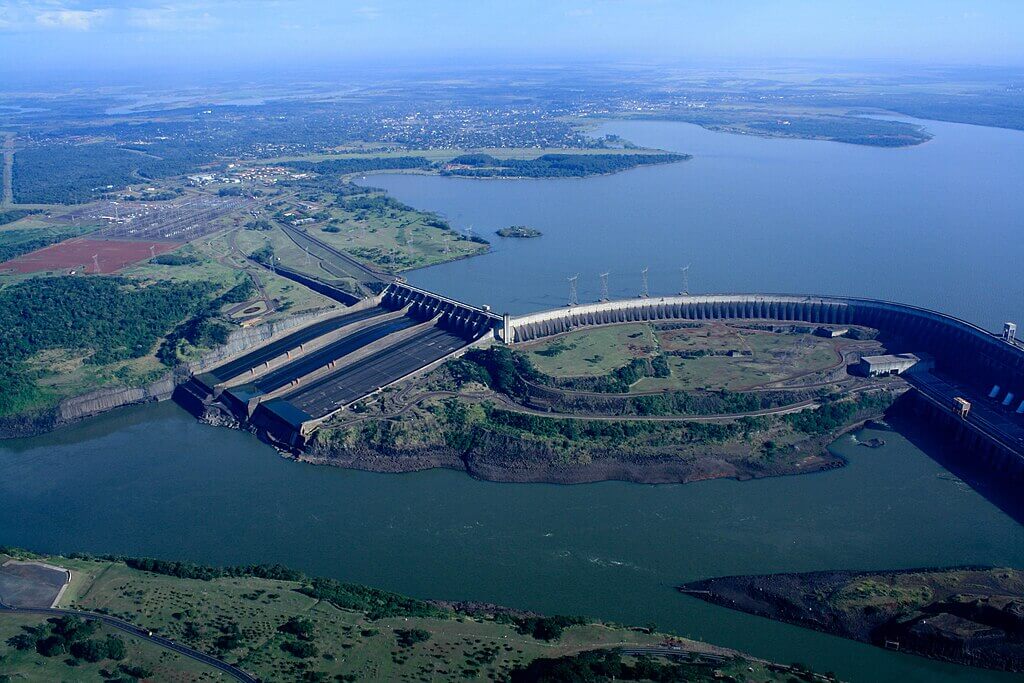
Itaipú: The Dam That Powers Paraguay and Brazil and Remade the Upper Paraná
Itaipú is a hydroelectric dam on the Paraná River, on the Brazil-Paraguay border, and one of the largest power plants ever built. Brazil and Paraguay own it in equal shares through a binational company, Itaipú Binacional, and its 14,000 megawatts of installed capacity make it the world's third-largest hydroelectric plant. It supplies most of Paraguay's electricity and a tenth of Brazil's, and it created a reservoir that changed the ecology and the people of the upper Paraná River.
Location and Structure
The dam stands between the Brazilian city of Foz do Iguaçu and the Paraguayan town of Hernandarias, a short distance upstream of the Friendship Bridge and the confluence with the Iguazu River. It combines concrete buttress, gravity, and embankment sections along a line 7,919 meters (25,981 feet, or 4.9 miles) long, and its highest point is 196 meters (643 feet). The spillway can pass 62,200 cubic meters per second (2.2 million cubic feet per second).
The powerhouse holds 20 generating units of 700 megawatts each, working under a hydraulic head of 118 meters (387 feet). Ten units run at 50 hertz, the standard in Paraguay, and the other ten run at 60 hertz, the standard in Brazil. Output has varied with rainfall, from a record 103.1 terawatt-hours in 2016 to about 76.4 terawatt-hours in 2020, when the plant ran at roughly 62 percent of its capacity.
A Project Built by Treaty
Brazil and Paraguay began studying the river's potential in the Act of Iguaçu, signed on June 22, 1966, and they signed the Itaipú Treaty on April 26, 1973, when both countries were ruled by military governments. Construction began in 1975; the river was diverted in October 1978, and the reservoir began to fill on October 13, 1982. The first generating unit started on May 5, 1984; the first 18 units were running by 1991, and the last two were added in 2006 and 2007.
The Reservoir
The reservoir covers 1,350 km² (521 square miles), of which about 770 km² (297 square miles) lie in Brazil and about 580 km² (224 square miles) in Paraguay. It reaches about 170 kilometers (106 miles) upstream, is up to 12 kilometers (7.5 miles) wide, and holds about 29 cubic kilometers (7 cubic miles) of water. Its rise drowned Guaíra Falls (Sete Quedas), one of the most powerful waterfalls on Earth, and Brazil closed the national park that protected it.
The falls had also served as a natural barrier that kept the fish of the upper Paraná, many of them found nowhere else, separate from those downstream. Once the falls disappeared, species from each side could move into the other, causing the kind of problems usually linked to introduced species. Around the reservoir itself, a study cited by Itaipú Binacional found that on the Brazilian side only about 23 percent of the land was forest and about half was farmland.
Power, the Treaty, and the Tariff
The treaty gives each country half of the plant's output, and Paraguay sells the surplus it does not use to Brazil. In 2022, Brazil used about 75 percent of the energy the dam produced, while Paraguay used the remaining 25 percent, which covered most of its national electricity demand. Itaipú Binacional now puts its share of supply at roughly 90 percent of Paraguay's electricity and about 10 percent of Brazil's.
The financial rules sit in Annex C of the treaty, which sets the plant's costs and electricity prices. The construction debt was paid off by 2023, and the treaty-mandated review of Annex C after 50 years has been tense. In May 2024, the two governments set a tariff of US$19.28 per kilowatt-month for 2024 through 2026, up from US$16.71 in 2023; at that rate, Paraguay receives about US$1.25 billion a year. The arrangement expires on December 31, 2026. Brazil has argued that the tariff should cover only operating costs, while Paraguay's president, Santiago Peña, has said Paraguay will not accept a reduction. Talks were suspended in April 2025 after a Brazilian intelligence operation came to light, and they resumed later. In March 2026, Presidents Lula and Peña agreed to speed up the negotiations, and Itaipú has committed US$285 million in 2026 to hold the price steady for regulated consumers in southern Brazil.
People Displaced by the Dam
An estimated 10,000 families who lived beside the river were displaced when construction began in the early 1970s. Among them were Avá Guaraní communities, whose lands in western Paraná State and eastern Paraguay were flooded or taken over. In March 2025, Brazil's Supreme Federal Court approved a settlement under which Itaipú Binacional will buy 3,000 hectares (30 km² or 12 square miles) for 31 communities in the Tekoha Guasu Guavirá and Tekoha Guasu Ocoy Jakutinga territories, which together hold more than 5,000 people. The communities accepted it as an immediate remedy but said it does not cover the full damage. Amnesty International has noted that equivalent progress has not been made for Avá Guaraní communities on the Paraguayan side.
Conservation Around the Reservoir
Itaipú Binacional manages forest reserves and biological refuges on both shores, among them the Tatí Yupí and Mbaracayú refuges in Paraguay and the Bela Vista Biological Refuge in Brazil. On the Brazilian side, a strip of reforested land about 34,000 hectares (340 km² or 131 square miles) wide runs along the reservoir banks, and the company says it has planted about 44 million trees on both shores. The Paraguayan protected areas gained biosphere reserve status in 2017 and the Brazilian ones in 2019, as a core zone of UNESCO's Atlantic Forest Biosphere Reserve, a designation the company says is unique for a hydroelectric plant. The reserves shelter the lowland tapir (Tapirus terrestris), the capybara (Hydrochoerus hydrochaeris), and many other Atlantic Forest animals. See the separate article on the Itaipú Biosphere Reserve for details.
Visiting Itaipú
Itaipú is also a tourist attraction. Tours of the plant and its panoramic and night-lit displays run on both shores, and the company reports more than 25 million visitors since 1977. A Paraguayan newspaper reported that nearly 900,000 people visited the company's attractions on the Paraguayan side in 2025. Most visitors combine the dam with a trip to Iguazu Falls or a stop in Ciudad del Este, which lies just across the river from Foz do Iguaçu.
Challenges Ahead
Water supply is the most direct challenge, because output depends on rainfall across a basin of about 1.35 million km² (521,000 square miles). During the severe drought that began in late 2019, Paraguayan officials said low water pushed Itaipú close to shutting down, and in July 2026 the plant opened a floodgate to help vessels move downstream. The treaty talks add a financial challenge, because the price Brazil pays will affect Paraguay's budget, and the unresolved claims of the Avá Guaraní add a social one.
Conclusion
Itaipú shows how a single project can serve two national energy systems while reshaping a river and the lives of people along it. Its future will depend on a new tariff agreement, rainfall in the basin, and whether the company's conservation and restitution programs reach the people and habitats the reservoir displaced.