
The Serranía del Baudó: Colombia's Hidden Biodiversity Sanctuary
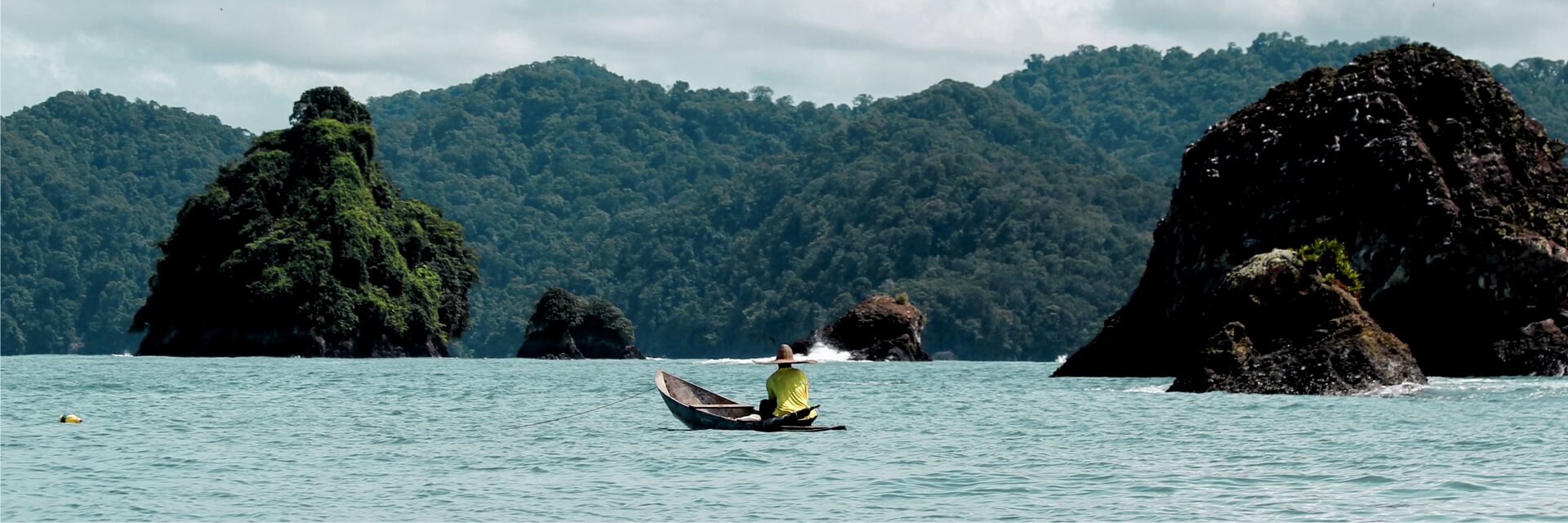
Colombia's Pacific coast is home to one of the world's most remarkable yet least understood mountain ranges. Rising from the humid lowlands of the Chocó department, the Serranía del Baudó represents far more than a geographical feature—it stands as a critical sanctuary for biodiversity.
Between Ocean and Andes: The Ecological Significance of the Serranía del Baudó
Colombia's Pacific coast is home to one of the world's most remarkable yet least understood mountain ranges. Rising from the humid lowlands of the Chocó department, the Serranía del Baudó represents far more than a geographical feature—it stands as a critical biodiversity sanctuary and a testament to the complex interplay between topography, climate, and evolution in the Neotropics. The Serranía del Baudó is a recognized center of terrestrial and aquatic biodiversity, and a source of fish species for Mesoamerica. Yet, scientific exploration of this region remains remarkably limited, leaving numerous biological treasures yet to be discovered.
Geographic Location and Formation
The Serranía del Baudó is a coastal mountain range on the Pacific coast of Colombia, situated between the West Andes and the Atrato Valley, where the Atrato River flows and Quibdó is located. The range extends northward from the Baudó River, following the coastline into Panama, where it becomes known as the Serranía del Sapo. Elevations rise dramatically from the coastal plain to peaks exceeding 5,750 metres (18,865 feet) along the Cordillera Occidental of the Andes, though the Baudó range itself maintains more modest elevations.
The Serranía del Baudó serves as one of the defining mountain massifs within the Chocó-Darién moist forests ecoregion, which is one of the most species-rich lowland areas in the world. This ecoregion extends from eastern Panama through almost the entire Colombian Pacific coast, encompassing the departments of Chocó, Cauca, Valle del Cauca, and Nariño. The Serranía del Baudó, along with other mountain ranges such as the Serranía del Darién and Sierra Llorona de San Blas, forms the topographic foundation that intercepts moisture-laden air from the Pacific Ocean, generating the extreme precipitation patterns that characterize the broader Chocó-Darién moist forests system.
The geological foundation of the Serranía del Baudó reflects the region's complex tectonic history. The terrain comprises recently formed alluvial plains, hills formed during the Tertiary and Pleistocene periods through the dissection of sediments, and older Mesozoic-era rocks in the mountains. This diverse geological substrate contributes to the varied habitats that support the region's exceptional biodiversity.
Climate and Environmental Conditions
The Serranía del Baudó experiences one of the world's most extreme precipitation regimes. The region's position between the Pacific Ocean and the Andes creates a unique microclimate that supports lush tropical rainforests. The soils are typically red clay laterite, leached of most nutrients by the heavy rain, creating challenging conditions that have nonetheless fostered remarkable evolutionary adaptations.
The climate patterns in the Serranía del Baudó are closely tied to its location within the Chocó biogeographic region. The ecoregion is located between the Pacific Ocean and the Western Ranges of the Andes, with elevations ranging from sea level to approximately 1,000 meters (3,300 feet). These environmental conditions create a natural laboratory for speciation and endemism.
Biodiversity and Ecological Significance
The biological richness of the Serranía del Baudó defies easy categorization. The biosphere reserve contains a variety of landscapes (cliffs, estuaries, coastlines, gulfs, inlets, bays and marine areas) and ecosystems (reefs, mangroves, and tropical forest) rich in biodiversity. The region's flora demonstrates remarkable diversity, with comprehensive botanical surveys revealing intricate forest communities.
Plant Diversity and Forest Structure
Research conducted in the Alto Baudó municipality offers valuable insights into the region's botanical diversity. The floristic composition of the Alto Baudó forest was represented by 1,618 individuals, 56 families, 156 genera and 257 species. The dominant plant families include Rubiaceae, Arecaceae, Bombacaceae, Moraceae, Clusiacaea, Flacourtiaceae, Melastomataceae, Myristicaceae, Sapindaceae, and Annonaceae, reflecting the typical composition of Neotropical rainforests.
The forest structure reveals the complex vertical stratification characteristic of tropical rainforests. The Serranía del Baudó is characterized by dense rainforests, cascading waterfalls, and a diverse array of unique plant and animal species. The Shannon diversity index of 4.43 calculated for the region indicates exceptionally high species diversity, particularly considering the limited sampling area of 0.2 hectares.
Aquatic Biodiversity
The freshwater systems of the Serranía del Baudó represent critical habitats for endemic species. This ecoregion is composed of many independent, short rivers in small watersheds. These are high-gradient, narrow rivers with little or no floodplains and base-level channels that are short and shallow. The unique hydrology of these coastal streams creates specialized niches for aquatic fauna.
The region's aquatic biodiversity includes both freshwater and marine-influenced species. In the coastal streams of the Chocó Biogeographic region, the primary freshwater species present are of Andean origin, suggesting complex biogeographical connections between the mountains and coastal ranges.
Conservation Challenges and Opportunities
The Serranía del Baudó faces significant conservation challenges, despite its ecological importance. The project's objective is to develop a strategy for the sustainable use and conservation of biodiversity, involving the participation of local communities and administrations. Conservation efforts must strike a balance between biodiversity protection and the needs of local communities, which depend on the region's natural resources.
The integration of traditional ecological knowledge with scientific research represents a crucial approach for effective conservation. The project supports dialogue and lays the basis for a more environmentally grounded development plan for the region given that the recently proposed development programs for the region have presented conceptual and methodological differences in approach with respect to the cultural systems of its inhabitants and to their relationship with the natural environment.
Scientific Research and Knowledge Gaps
Despite its biological significance, the Serranía del Baudó remains one of the least scientifically explored regions in Colombia. However, little is known about the local and regional patterns of diversity in its ichthyofauna, largely due to limited scientific exploration. These knowledge gaps represent both challenges and opportunities for future research.
The region's limited accessibility, combined with security concerns and logistical challenges, has historically restricted scientific investigation. However, recent advances in remote sensing technology and collaborative research approaches with local communities offer new possibilities for understanding the region's biodiversity.
Regional and Global Significance
The Serranía del Baudó's importance extends beyond Colombian borders. As part of the Chocó biogeographic region, it serves as a critical link in the broader Mesoamerican Biodiversity Corridor. The region's endemic species contribute to global biodiversity patterns and provide insights into evolutionary processes in tropical environments.
The mountain range's position as a bridge between South and North America makes it particularly valuable for understanding biogeographical patterns. Species migration routes, evolutionary radiations, and ecological connections between different biogeographic regions can be studied through the lens of the ecosystems of Serranía del Baudó.
Future Prospects and Research Directions
The future of the Serranía del Baudó depends on the successful integration of conservation science, sustainable development, and community participation. Emerging technologies such as environmental DNA sampling, remote sensing, and citizen science initiatives offer new tools for biodiversity assessment and monitoring.
Climate change presents both challenges and opportunities for the region. While rising temperatures and altered precipitation patterns may threaten existing ecosystems, the elevational gradients of the Serranía del Baudó may provide refugia for species adapting to changing conditions.
Research priorities should focus on comprehensive biological inventories, ecological connectivity assessments, and the development of sustainable resource management strategies. The integration of traditional ecological knowledge with modern scientific approaches will be essential for effective conservation outcomes.
Summary
The Serranía del Baudó represents one of Colombia's most significant yet understudied biodiversity hotspots. Its unique geographical position, extreme precipitation patterns, and complex geological history have created conditions that support extraordinary biological diversity. From the intricate forest communities with their remarkable plant diversity to the specialized aquatic ecosystems harboring endemic species, the region demonstrates the incredible richness of Neotropical environments.
The conservation of the Serranía del Baudó requires urgent attention, given the mounting pressures from development activities and climate change. Successful conservation strategies must integrate scientific research with community participation and sustainable development approaches to achieve effective outcomes. The region's role as a bridge between biogeographic regions and its contribution to global biodiversity patterns underscore its international significance.
Future research efforts should prioritize comprehensive biological inventories, ecological connectivity studies, and the development of sustainable resource management frameworks. The Serranía del Baudó stands as a testament to the remarkable biodiversity of Colombia's Pacific coast, serving as a critical sanctuary for countless species yet to be discovered by science.
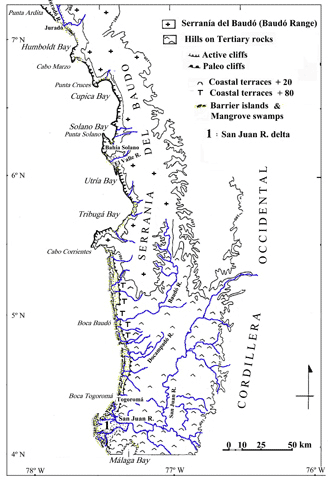
Map depicting the location of the Serrania Del Baudó.