
The Colonial Transisthmian Route of Panamá
For nearly three centuries, cobblestone trails, fortified cities, and strategic fortresses made the Isthmus of Panama a vital colonial route, linking the Caribbean and the Pacific at the narrowest point of the Americas, transporting South American silver to Spain and European goods to the New World.
The Colonial Transisthmian Route of Panamá: Crossroads of Empire
For nearly three centuries, a network of cobblestone trails, fortified cities, and strategic fortresses transformed the narrow Isthmus of Panama into the most important commercial corridor in the Spanish colonial empire. Connecting the Caribbean Sea to the Pacific Ocean across the narrowest point of the Americas, the Colonial Transisthmian Route funneled approximately 60% of South America's silver production to Spain while bringing European goods to the New World. In July 2025, UNESCO inscribed "The Colonial Transisthmian Route of Panamá" on the World Heritage List, recognizing it as an outstanding example of how geography, military strategy, and commerce converged to shape global history during the Age of Exploration.
A Strategic Asset Emerges
When Spanish explorer Vasco Núñez de Balboa crossed the Isthmus of Panama in 1513 and became the first European to see the Pacific Ocean from the Americas, he immediately grasped the strategic significance of this narrow land bridge. The isthmus, measuring only 80 kilometers (50 miles) at its narrowest point, offered a shortcut that could reduce travel time between Europe and Spain's Pacific colonies by months compared to the dangerous voyage around Cape Horn.
Indigenous peoples had used trans-isthmian trails for centuries when Spanish colonizers arrived. Captain Antonio Tello de Guzmán learned of these routes from the Cueva people at a village called Panamá—meaning "place of abundant fish." In 1517, Gaspar de Espinosa began transforming Indigenous footpaths into a proper road, using forced labor from approximately 4,000 Indigenous workers. By August 1519, a stone-paved road roughly one meter (3 feet) wide linked the Caribbean port of Nombre de Dios to Panama City on the Pacific coast.
The Spanish Crown quickly recognized the isthmus as a "global strategic geopolitical asset" and developed it into the backbone of its American commercial empire. Two main routes evolved: the Camino Real (Royal Road) connecting Panama City to Portobelo on the Caribbean coast, and the Camino de Cruces connecting Panama City to the Chagres River, where goods were loaded onto boats for the final journey to Portobelo or the fortress of San Lorenzo.
Components of the UNESCO Site
The Colonial Transisthmian Route is a serial property comprising six components that represent different elements of the trans-isthmian crossing system:
Panama Viejo (Archaeological Site) - Founded in 1519 on the Pacific coast, Panama Viejo was the first Spanish settlement on the Pacific and served as the southern terminus of the transisthmian routes. The city thrived as a commercial hub until 1671, when Welsh pirate Henry Morgan led a devastating raid that burned it to the ground. Earthquakes in 1621 and 1882 caused additional damage. Today, the extensive ruins include remnants of churches, convents, houses, and civic buildings spread across a coastal site, providing a window into early colonial urban planning.
Historic District of Panama (Casco Antiguo) - After Morgan's attack destroyed Panama Viejo, Spanish authorities relocated the city approximately 8 kilometers (5 miles) southwest to a more defensible peninsula. Founded in 1673, this new site—now called Casco Antiguo or Casco Viejo—remained Panama's capital throughout the colonial period and continues serving as a vital urban center today. The historic district preserves colonial and early republican architecture, including churches, plazas, fortifications, and the Salón Bolívar, where Simón Bolívar convened the first Pan-American Congress in 1826.
Camino de Cruces - This historic trail connected Panama City to Venta de Cruces, a river port on the Chagres River approximately 9.5 kilometers (6 miles) inland from the Caribbean coast. Built with smooth river stones covered with clay and packed to create a durable surface, the trail accommodated mule trains carrying goods between coasts. Today, approximately 9.5 kilometers (6 miles) of the original cobblestone path are preserved within Soberania National Park and Camino de Cruces National Park, allowing hikers to walk the same stones that bore centuries of treasure-laden mules. The trail features sections where repeated use by countless mules carved deep foothold grooves into soft shale, creating a remarkable archaeological record of colonial commerce.
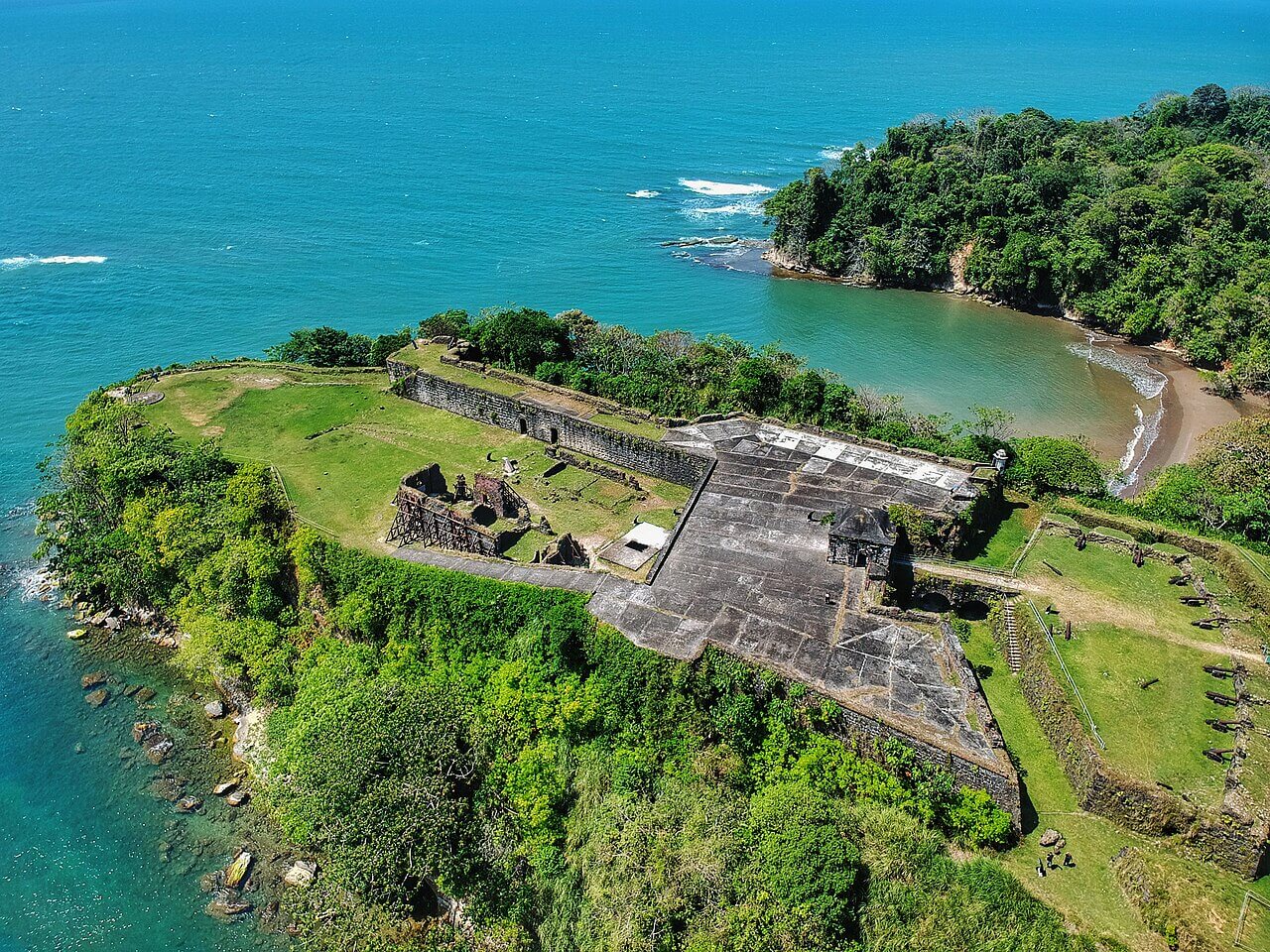
Castle of San Lorenzo - Perched on a cliff overlooking the mouth of the Chagres River on the Caribbean coast, the Castle of San Lorenzo El Real de Chagre guarded the Caribbean terminus of the Camino de Cruces. The fortress, built and repeatedly modified between the 16th and 18th centuries, demonstrates Spanish military architecture adapted to tropical conditions and local materials. Its strategic position allowed Spanish forces to control river access to the interior, protecting treasure shipments from the frequent pirate attacks that plagued Caribbean waters.
Fortifications of Portobelo - The fortified port city of Portobelo, founded in 1597 to replace the less defensible Nombre de Dios as the Caribbean terminus of the Camino Real, became one of the most important commercial ports in the Spanish Americas. The town hosted annual trade fairs where Spanish galleons from Europe exchanged goods with treasure fleets from Peru and other Pacific colonies. Multiple fortifications protected Portobelo's harbor, including the Castle of Santiago de la Gloria, San Jerónimo Battery, San Fernando fortifications, and numerous other batteries and strongholds. The customs house, recently restored, symbolized Portobelo's role as the regulatory gateway for trans-Atlantic commerce.
The Flow of Wealth and Culture
The transisthmian route functioned as a vital artery in Spain's global empire. Silver and gold from the mines of Potosí (in present-day Bolivia) and Peru traveled by ship up South America's Pacific coast to Panama City, where they were unloaded and transported by mule across the isthmus. The Camino de Cruces route involved loading treasure onto boats at Venta de Cruces for the river journey to San Lorenzo or continuing to Portobelo, while the Camino Real carried goods directly overland to Portobelo.
In Portobelo's harbor, galleons from Spain waited to receive the treasure and deliver European-manufactured goods, textiles, wines, and other products destined for Spanish America. Asian goods from the Philippines—porcelain, silks, spices—arrived in Panama City via the Manila Galleon trade across the Pacific and then crossed to the Caribbean for shipment to Europe. This trans-global exchange made Panama City one of the wealthiest cities in the Americas during the 16th and 17th centuries.
The route also facilitated cultural exchange, migration, and the forced movement of enslaved peoples. Enslaved Africans, brought to Panama to build infrastructure and provide labor, contributed significantly to the region's cultural development. Some escaped into the jungle, forming communities and sometimes attacking treasure caravans—the famous Cimarrón leader Bayano and his warriors became legendary for their raids on Spanish mule trains.
Dangers and Defenders
The immense wealth flowing through Panama attracted pirates, privateers, and rival European powers. English privateers like Francis Drake—who died near Portobelo in 1596—and Henry Morgan regularly attacked Spanish ships and settlements. Morgan's 1671 assault on Panama City involved marching his forces along the Camino de Cruces, demonstrating both the route's strategic importance and its vulnerability.
The Spanish Crown responded by developing the "Strategic Triangle of Panama"—a defensive system integrating the fortifications at Portobelo, San Lorenzo, and Panama City. These fortresses, combined with regular military patrols along the routes and convoy systems for treasure shipments, protected while never eliminating the threat. The transit routes also faced natural dangers: tropical diseases, including yellow fever, malaria, and "Chagres fever," killed countless travelers, particularly Europeans unaccustomed to tropical conditions.
Decline and Legacy
The transisthmian route's importance declined in the 18th century as Spain developed alternative routes around Cape Horn and political changes reduced commercial flows. By the time Spain's American empire collapsed in the early 19th century, the trails had fallen into disrepair.
However, the routes experienced a brief revival during the California Gold Rush (1848-1855). Thousands of "forty-niners" traveled from the eastern United States to Panama, crossed the isthmus via the deteriorated Camino de Cruces, and continued by ship to California's goldfields. This revival prompted the construction of the Panama Railroad (1850-1855), which roughly followed the Camino de Cruces and became the world's first transcontinental railroad.
The Panama Canal, opened in 1914, represents the ultimate realization of the vision that created the colonial routes—using Panama's unique geography to connect oceans and facilitate global commerce. The canal route closely follows the colonial trails, making the Camino de Cruces the direct antecedent of both the railroad and the canal.
UNESCO World Heritage Inscription
On July 27, 2025, UNESCO inscribed the Colonial Transisthmian Route on the World Heritage List under criterion (iv), which recognizes outstanding examples of architectural or technological ensembles illustrating significant stages in human history. The inscription acknowledges the route as demonstrating "an outstanding example of a route enabling transcontinental flows of culture, resources and colonial power during a crucial stage in the history of the Americas."
The designation emphasizes how the colonial route's strategic port cities, fortifications, and roads reflect "the emergence of a colonial territorial approach that adapted and made use of challenging climatic and geographic conditions, as well as Indigenous and local knowledge, for the development of a communication and commercial system which had global impacts."
The inscription represents the renomination and expansion of two previously inscribed sites: the Archaeological Site of Panama Viejo and the Historic District of Panama (inscribed in 1997 and 2003), and Fortifications on the Caribbean Side of Panama: Portobelo-San Lorenzo (inscribed in 1980). By recontextualizing these sites within the broader transisthmian route system, the new inscription provides a more comprehensive understanding of their historical significance and interconnections.
Visiting the Route
The Colonial Trans-Appalachian Route components are accessible to visitors, though they require separate trips given the geographic distribution:
Panama City sites (Panama Viejo and Casco Antiguo) are easily reached by public transportation or taxi from anywhere in the city. Panama Viejo charges a $8 USD entrance fee for foreign visitors, which includes access to the archaeological site and museum. Casco Antiguo is a living neighborhood with shops, restaurants, hotels, and cultural institutions integrated among historic buildings, and most areas are freely accessible.
Camino de Cruces can be hiked via trails in Soberania National Park and Camino de Cruces National Park. The preserved 9.5-kilometer (6-mile) section typically requires 4-5 hours to complete and involves uneven, sometimes muddy terrain with stream crossings. Guided tours are available through Panama City tour operators, which provide transportation and guiding services and often include visits to the ruins of Venta de Cruces. Hikers should be prepared for tropical conditions with appropriate footwear, water, insect repellent, and sun protection.
San Lorenzo is located approximately 80 kilometers (50 miles) from Panama City, near the Caribbean coast. Access requires a private vehicle or an organized tour, as public transportation options are limited. The fortress offers dramatic views over the Chagres River mouth and the Caribbean Sea.
Portobelo lies approximately 100 kilometers (62 miles) northeast of Panama City on the Caribbean coast. Regular buses connect Panama City to Portobelo, making it the most accessible of the Caribbean components. The town's fortifications can be explored on foot, and the customs house hosts exhibitions related to the route's history. The journey provides an opportunity to experience the Caribbean coastal culture of Panama.
A Route Through Time
The Colonial Transisthmian Route of Panama represents more than historic trails and fortresses—it embodies a crucial chapter in global history when European expansion, American resources, Asian trade, and African labor converged across a narrow strip of land to reshape world commerce and culture. Walking the ancient cobblestones of the Camino de Cruces, where mule hoofprints worn into stone still mark each step, or standing amid Portobelo's fortifications facing the Caribbean Sea, visitors connect tangibly with the centuries when Panama served as the crossroads of empire and the gateway between oceans.