
Nahuelbuta National Park: Chile's Coastal Monkey Puzzle Refuge
Nahuelbuta National Park, created in 1939 in Chile's Araucanía Region, protects a coastal stand of monkey puzzle trees and one of the few known mainland populations of the endangered Darwin's fox.
Nahuelbuta National Park: Monkey Puzzle Trees by the Sea, and the Fox That Wasn't Supposed to Be Here
Nahuelbuta National Park lies in the Nahuelbuta Range, part of the Chilean Coastal Range, between the communes of Angol and Purén in the Araucanía Region. The park covers about 6,800 hectares (16,800 acres), with its administration in Pehuenco, roughly 35 to 40 km (22 to 25 mi) from Angol, and is accessible by road from Angol and Cañete on the coast. Its forests climb to about 1,400 m (4,600 ft), and the monkey puzzle tree (Araucaria araucana), a conifer usually associated with the high Andes, survives here in an isolated stand close to the Pacific.
A Park for the Coastal Araucaria
The park was created by a decree of the Ministry of Lands and Colonization published on March 6, 1939, carved from the Vegas Blancas estate in the commune of Angol, with an initial area of 5,415 hectares (13,380 acres), and has since grown to 6,832 hectares (16,880 acres). Its stated purpose was to preserve the coastal araucaria, and it remains one of the best places to see the species outside the Andes. The park's Pehuenco stream feeds the Purén River in the Imperial River basin, which supplies the town of Purén.
The Monkey Puzzle Trees
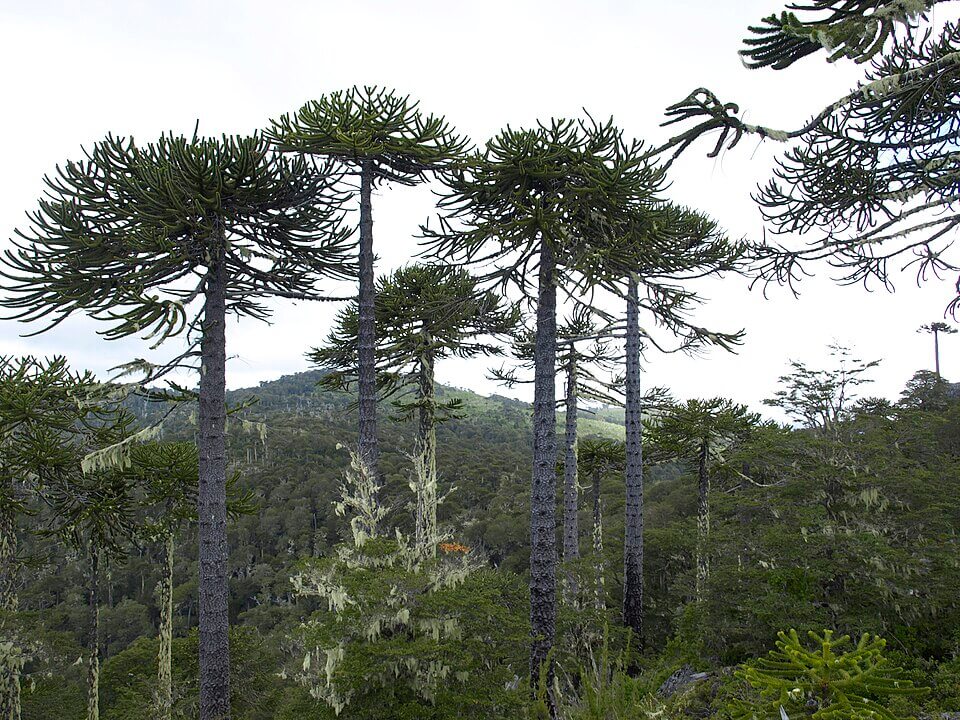
In Chile, the araucaria grows mainly in the Andes, between about 800 and 1,700 m (2,600 and 5,600 ft), with a discontinuous coastal distribution in the Nahuelbuta Range and the Altos de Tirúa at 600 to 1,400 m (2,000 to 4,600 ft). At Nahuelbuta, the trees stand in scattered groves at the higher elevations, draped in lichens, and the park's oldest, the "Araucaria milenaria," is a scarred giant with a fire-hollowed base; specimens in the range are estimated at around 2,000 years old. Winter snow often dusts the crowns at the higher elevations. The monkey puzzle forests of the high Andes, a very different setting for the same species, are described in our Tolhuaca National Park article, where fire has repeatedly tested them.
The araucaria, called pewén in Mapudungun, is sacred to the Mapuche, and its large seeds, the piñones, are a traditional staple for the Pehuenche, the Mapuche subgroup whose name means "people of the pewén." Heavy logging through the mid-twentieth century, along with fire and grazing, pushed the species toward extinction, and the IUCN listed it as Endangered in 2013. Chile declared it a natural monument in 1976, removed the status in 1987, and reinstated it in 1990, which ended legal logging; the species is also protected under CITES.
Beech Forests and Understory
Below the araucarias, the lower and middle slopes are covered with southern beech forests of rauli (Nothofagus alpina), coigüe (Nothofagus dombeyi), lenga (Nothofagus pumilio), and ñirre (Nothofagus antarctica), and the park also shelters insectivorous plants. CONAF classifies the vegetation as Alto Montano forest of Nahuelbuta and Concepción deciduous forest, within the Andean-Patagonian forest region, a mix that reflects the range's position between the Andes and the coast.
Darwin's Fox
Nahuelbuta is best known to biologists as the mainland home of Darwin's fox (Lycalopex fulvipes). For more than a century, this small, dark, short-legged canid, first collected by Darwin on Chiloé, was thought to live only on that island and to be a subspecies of the South American gray fox (Lycalopex griseus). Researcher Jaime Jiménez observed a small population in Nahuelbuta since 1975, reported it to science in the early 1990s, and genetic analysis then confirmed that the fox is a distinct species living about 600 km (370 mi) north of its island stronghold on Chiloé.
In the park, the foxes forage mainly at night, when the larger gray fox is less active, and the mainland population eats mostly small mammals, with reptiles, insects, birds, and arachnids making up the rest of its diet. In the early 2000s, the mainland population was estimated at fewer than 100 animals, and researchers noted that foxes face substantial mortality when they move in winter to lower, unprotected private lands around the park. Camera traps have since confirmed Darwin's fox in the Valdivian Coast Range, at Oncol Park, Alerce Costero National Park, and the Valdivian Coastal Reserve, so Nahuelbuta's population is no longer thought to be isolated, and the IUCN now lists the species as Endangered.
Other Wildlife
Nahuelbuta also shelters the pudú (Pudu puda), a diminutive deer, the puma (Puma concolor), which gave the range its name, and the Magellanic woodpecker (Campephilus magellanicus), which hammers the older trees. Nahuelbuta is a Mapudungun name usually translated as "great puma" or "great tiger."
A Contested Mapuche Landscape
The Nahuelbuta Range was a focus of the long Spanish-Mapuche conflict known as the Arauco War, and the Spanish built a string of settlements and fortified houses around it. The surrounding region remains at the center of tensions over land between Mapuche communities, the state, and forestry companies, tensions that have reached the park itself: on November 13, 2022, arsonists burned the ranger's house and administrative offices at Pehuenco, and CONAF temporarily closed Nahuelbuta and Tolhuaca national parks, a closure the regional presidential delegate asked it to reverse.
Threats and Controversies
Beyond the park's borders, the Nahuelbuta slopes have been heavily logged and converted to plantations and farmland, leaving the park as a forested island, and that isolation limits the wildlife that depends on it. Fire is a constant risk: CONAF closed the park's Portones sector in February 2023 during the wildfire emergency in the Araucanía Region and closed parks across the region again in January 2025 because of extreme heat. In 2021, Chile's Comptroller General reported that CONAF crews had illegally cut at least 51 araucarias in the park while clearing an unused road for a firebreak, without the park administrator's direct supervision. CONAF ended the contracts of the administrator and the brigade leaders involved.
Visiting the Park
The CONAF information center and campground are at Pehuenco, where the most popular trail begins and climbs to the Piedra del Águila lookout, a rock outcrop at roughly 1,400 m (4,600 ft) with views across the range to the Pacific on clear days and, in the other direction, to the Andes. Other shorter routes cover the park's araucaria groves and the old tree itself, and the park is sometimes closed during high fire risk.
Conclusion
Nahuelbuta is a small park carrying large responsibilities: the last substantial refuge of the coastal araucaria, a place where a canid unknown on the mainland until recently still hunts in the dark, and a testing ground for how Chile balances conservation with the pressures of the forestry industry and its history of land conflict. Its survival will continue to depend as much on what happens outside its boundaries as on what happens inside them.