
Salar del Huasco National Park: A Wetland Above 12,000 Feet, Declared Twice
Salar del Huasco National Park protects a high-Andean wetland in Chile's Tarapacá altiplano where three flamingo species nest on shallow lagoons; it has been a Ramsar site since 1996 and a legally created national park since 2023, in a landscape sacred to the Aymara and closely watched by mining companies.
Salar del Huasco National Park: Flamingos, Aymara Heritage, and the Fight over Altiplano Water
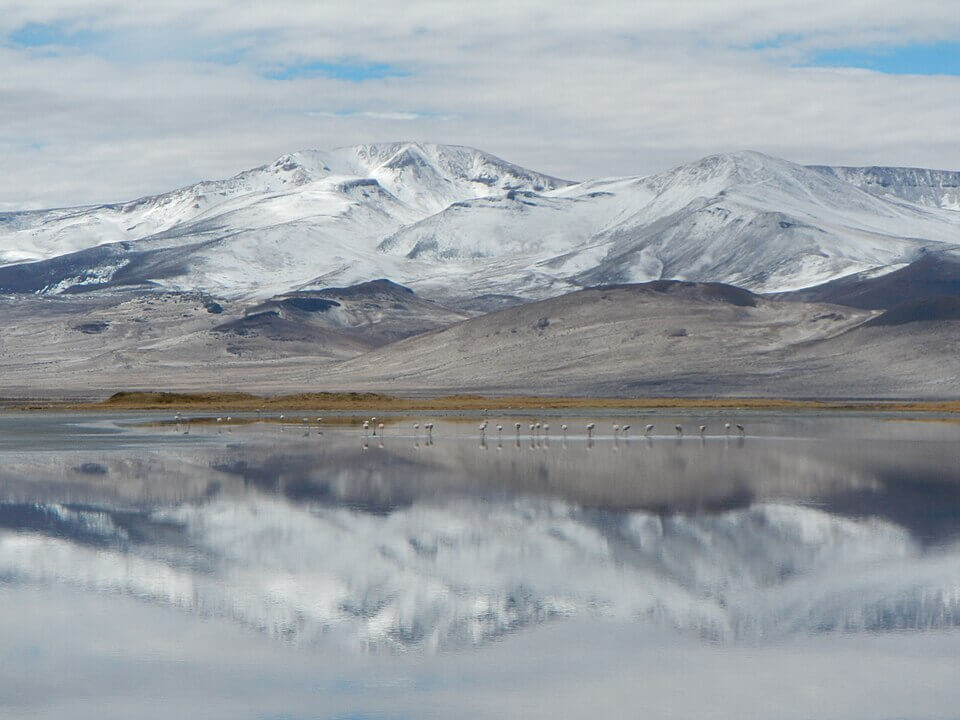
Salar del Huasco National Park lies in the commune of Pica, in the Tarapacá Region of northern Chile, at about 3,800 m (12,500 ft) on the altiplano, roughly 150 km (93 mi) east of Iquique. It covers 110,049 hectares (about 272,000 acres), and the salar itself lies at the center of two north-south ridges that rise above 4,500 m (14,800 ft). The park protects the whole basin of the salar, about 1,500 sq km (580 sq mi) of steppe, bofedal wetlands, and shallow lagoons that Chile's environment ministry has described as one of the most pristine wetlands in the altiplano and an important water reserve in the driest desert on Earth. Farther north in Tarapacá, Volcán Isluga National Park protects another stretch of Aymara altiplano, and with the Pampa del Tamarugal National Reserve, it is one of the other two protected areas CONAF manages in the region.
A Basin Left by an Ice Age Lake
The salar is the remnant of a large lake that filled the basin during the Pleistocene. A wave-cut terrace about 30 m (98 ft) above the present salar marks that ancient shoreline, and a river delta formed where the Collacagua River, which rises above 4,000 m (13,100 ft) and runs the length of a north-south valley, entered the lake. As the lake dried, it left behind a salt flat and a few shallow, brackish lagoons at the southern end of the valley, where the western lagoons that attract flamingos have an average depth of only about 18 cm (7 in). Three aquifers in the basin fill are hydrologically connected to both the Collacagua River and the salar and help sustain the wetland.
Flamingos and Other Wildlife
The Huasco lagoons are best known for their flamingos. The salar hosts all three South American species, the Chilean flamingo (Phoenicopterus chilensis), the Andean flamingo (Phoenicoparrus andinus), and James's flamingo (Phoenicoparrus jamesi), whose ecology is covered in more depth in our Los Flamencos Reserve article, and its ecological conditions allow nesting colonies of the birds, making it one of Chile's flamingo breeding sites. Other waterbirds and wetland birds include the Andean goose (Chloephaga melanoptera), the Andean gull (Chroicocephalus serranus), ducks, and the suri, or Darwin's rhea (Rhea pennata tarapacensis). The wetland's native fish, the killifish Orestias agassii and the catfish Trichomycterus rivulatus, and a water frog, Telmatobius peruvianus, are specialists of high Andean waters, while mammals include the vicuña (Vicugna vicugna), the culpeo, or Andean fox (Lycalopex culpaeus), the tuco-tuco (genus Ctenomys), and the puma (Puma concolor), which Chile classifies as Near Threatened.
Steppe and Bofedales
The predominant vegetation is high Andean steppe, in the Central Andean dry puna, dominated by bunchgrasses such as Festuca chrysophylla, with a patchwork of bofedales, the cushion-plant wetlands fed by springs, around the lagoons. Chile's environment ministry counts more than 200 terrestrial and aquatic plant species in the area.
An Aymara Landscape
The salar has long been a pastoral and sacred landscape. Aymara families have herded llamas (Lama glama) and alpacas (Vicugna pacos) on its bofedales for generations, and the 1996 Ramsar sheet already noted that the salt marsh is a source of Aymara rites and myths. The park protects archaeological sites and cultural features of Aymara cosmology, including Cerro Charcollo and the apachetas, stone cairns built as offerings. The park lies within the Jiwasa Oraje Indigenous Development Area, established in 2021, and the Aymara Indigenous Association Laguna del Huasco is among the groups that hold land and water rights in the basin; CONAF administers the park in a participatory framework that includes Indigenous communities. A 2025 proceeding before Chile's environmental superintendency over a livestock shed built within the park shows that questions of how traditional herding fits within the protected area are still being worked out, with Aymara associations arguing that the park's founding decree recognizes traditional use.
Declared Twice
The salar's protection came in stages. In 1996 it was named Ramsar Site 874, covering about 6,000 hectares (14,800 acres), though at the time it had no status in Chile's national protected-area system. In June 2010, a decree published in the Diario Oficial set aside state land for conservation at the salar, and Chilean media reported that it had become a national park, a description Wikipedia still repeats. The formal creation required consultation with Indigenous peoples under ILO Convention 169, which concluded in 2017, and in August 2018 the Council of Ministers for Sustainability approved the park as the first wetland protected under Chile's National Wetlands Protection Plan and the largest in that plan. President Sebastián Piñera announced it in August 2020, and Supreme Decree 66 of the Ministry of National Assets, published in the Diario Oficial on March 1, 2023, created Salar del Huasco National Park, the country's 42nd, which is about eighteen times the size of the original Ramsar area.
Water, Mining, and the Pica Oasis
Water is the park's central issue. Huge copper mines in the Tarapacá altiplano, such as Collahuasi, rely on groundwater, and the Ramsar sheet recorded in 1996 that a plan to pump water from the aquifer to supply the coastal city of Iquique was pending. Hydrogeological studies have modeled the effects of pumping on the salar, and the question of how the wetland connects to the springs that supply farms in the oasis town of Pica, about 59 km (37 mi) from the salar, has been debated, with some farmers fearing that mining or livestock use could shrink the springs on which the oasis depends. Regional disputes over groundwater extraction have repeatedly reached Chile's environmental courts, and the park's creation was meant in part to give the basin a firmer legal footing. I have not found evidence of current pumping in the basin, so the situation remains one to watch. Similar conflicts between mining water use and fragile salt-flat ecosystems, centered on lithium, are covered in our Salar del Hombre Muerto and Salinas Grandes article.
Visiting the Park
The salar is reached from Pica by gravel roads that pass close to the lagoons, and visitors should expect high altitude, cold nights, strong winds, and few services. The best time for flamingo watching is during the nesting season, when the birds gather at the Huasco lagoons, and visitors should keep their distance from nesting birds. CONAF manages the park together with Indigenous communities and is the best source of current access and closure information.
Conclusion
Salar del Huasco shows how Chile now protects a landscape that is sacred, pastoral, and rich in scarce water all at once: a wetland recognized internationally in 1996, declared a park in 2010, and legally created only in 2023, after the communities who live there were consulted. Its future will hinge on the water beneath it and the balance among the flamingos, the herders, and the surrounding mines.