
The Petén Basin and Maya Forest: Where Ancient Civilizations Meet Living Wilderness
The Petén Basin in northern Guatemala is the historical heartland of Classic Maya civilization and the core of the 14-million-hectare Maya Forest, the second-largest rainforest in the Americas — a landscape where Tikal, Calakmul, and El Mirador rise from unbroken jungle, now protected by a growing network of biosphere reserves spanning three countries.
The Petén Basin and Maya Forest: Guatemala's Green Heart of the Maya World
In the heart of Central America, where the borders of Guatemala, Mexico, and Belize converge, lies one of the world's most remarkable convergences of natural wonder and human achievement. The Petén Basin and its encompassing Maya Forest represent far more than geographical features—they embody the long relationship between civilization and wilderness that has unfolded across this landscape for millennia, where limestone pyramids rise through the forest canopy, and jaguars still move along pathways once traveled by Maya kings.
The Petén Basin: Cradle of Maya Civilization
Rising from the Caribbean lowlands like a vast natural amphitheater, the Petén Basin encompasses 35,854 sq km (13,843 sq mi) of northern Guatemala's most historically significant terrain. This expansive limestone platform, shaped by millions of years of geological processes, served as the stage upon which one of humanity's most sophisticated civilizations reached its height.
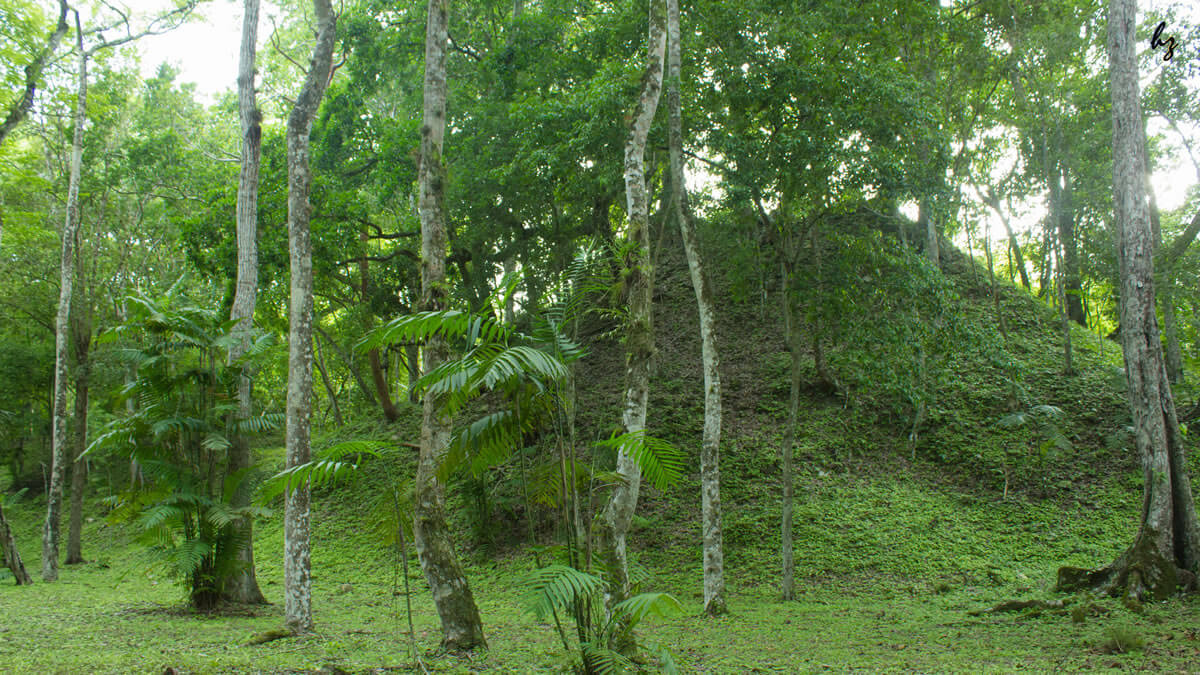
The basin's topography consists largely of low limestone plateaus stretching beneath the forest canopy, their surfaces punctuated by subtle undulations that mark ancient beach ridges from long-vanished seas. Scattered low hills rise here and there from the otherwise level terrain, their slopes cloaked in dense vegetation.
During the Late Preclassic and Classic periods, roughly 400 BCE to 900 CE, this landscape supported one of the ancient world's most densely populated regions. Archaeological evidence suggests that at its height around 750 CE, the Petén Basin was home to several million people, with some areas supporting population densities approaching 2,000 individuals per square kilometer, rivaling many modern cities. This was achieved entirely within what we would today recognize as a tropical rainforest environment, a remarkable feat of pre-industrial land and water management.
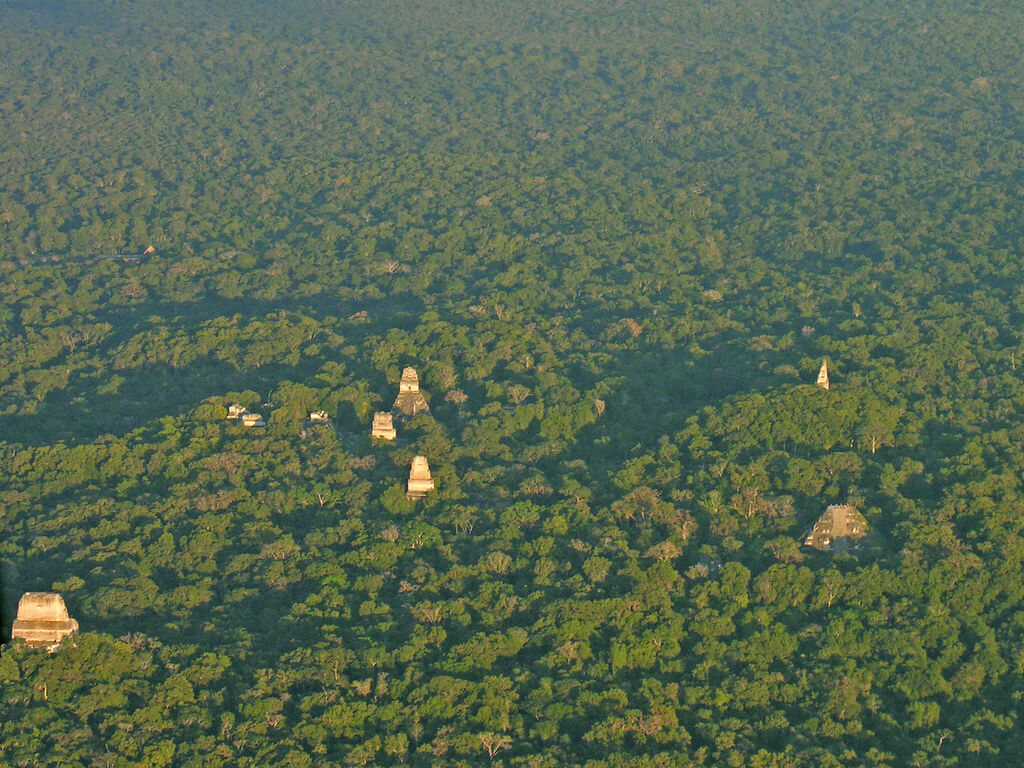
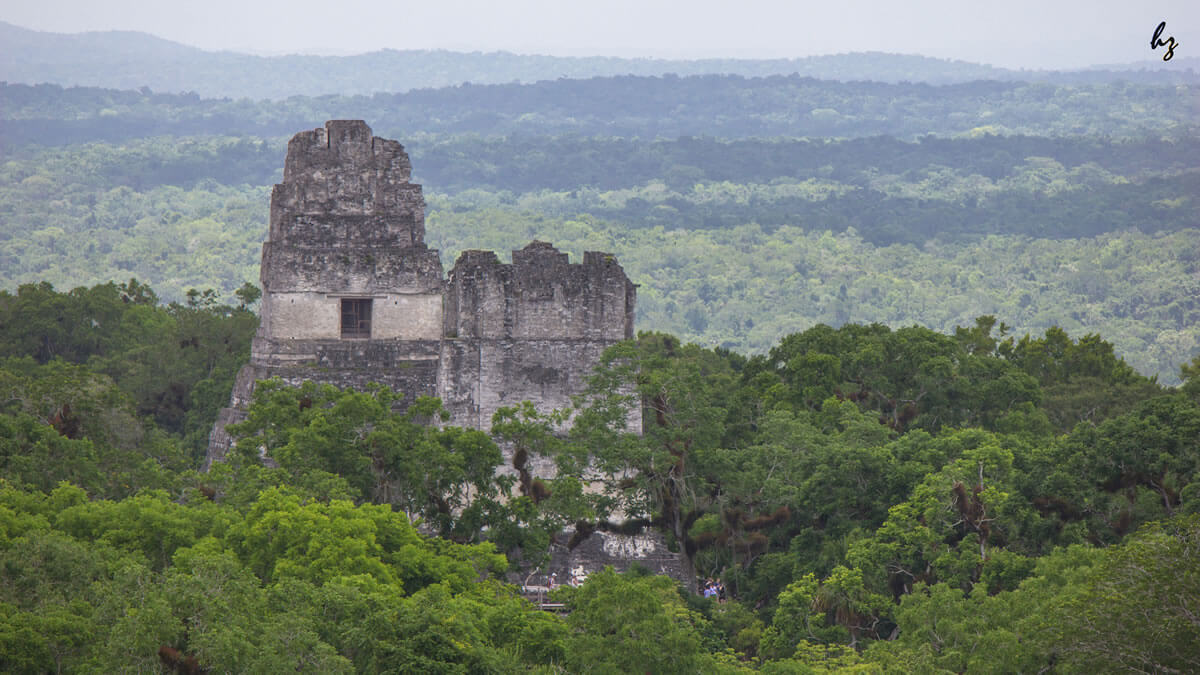
The great cities that arose from this landscape, Tikal, Calakmul, El Mirador, Yaxhá, and dozens of others, grew from the forest rather than being imposed upon it, their builders working within the natural contours of the land. These urban centers developed what scholars now recognize as the distinctive "Petén style" of Maya architecture: towering pyramid-temples emerging from the forest canopy, their limestone facades carved with hieroglyphic texts recording the deeds of kings whose names still survive in the archaeological record.
The Hidden Hydrology of Petén
One of the Petén Basin's most significant features lies not on its surface but deep beneath the forest floor. The region's limestone foundation has been slowly dissolving for millions of years, creating an extensive underground system of caves, rivers, and caverns that ranks among the most complex hydrological networks in the Americas.
Unlike regions with abundant surface water, the Petén Basin receives generous tropical rainfall, often exceeding 2,000 mm (78 in) annually, only to see it disappear almost immediately into the porous limestone bedrock. This water does not simply vanish; it travels underground for decades or even centuries, flowing through limestone galleries that stretch for hundreds of kilometers beneath the forest floor.
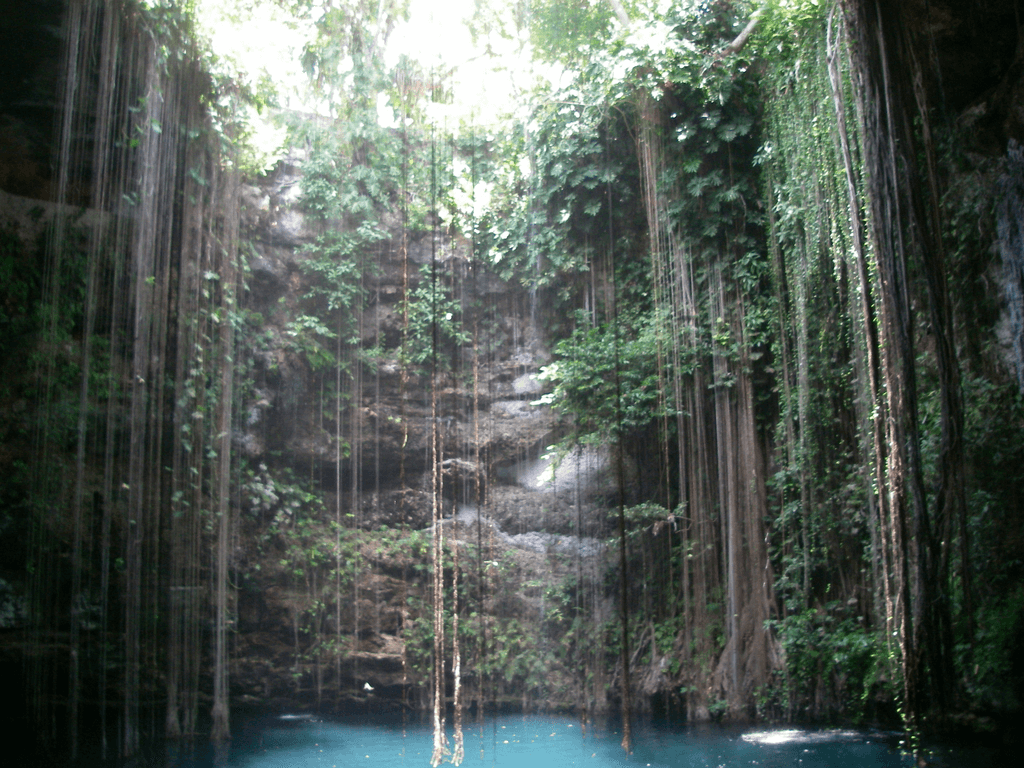
These subterranean rivers emerge periodically as cenotes, natural sinkholes filled with clear water that the ancient Maya considered sacred portals to the underworld. The word derives from the Maya "dzonot," meaning sacred well, and these formations served as focal points for significant religious ceremonies. Archaeological evidence from cenotes throughout the region reveals offerings of jade, gold, ceramics, and, in some cases, human sacrifice, underscoring the profound spiritual significance these waters held. Cave systems served related functions, becoming sacred spaces where priests conducted ceremonies honoring rain gods and earth deities within a Maya cosmology that envisioned the underworld as a watery realm; modern archaeological exploration continues to reveal ceramic vessels, stone altars, and hieroglyphic inscriptions deep within these caverns, evidence of ritual activity that continued for centuries.
This underground hydrological system remains vital today, its extensive aquifer supplying freshwater for both wildlife and the communities that call the region home. Lake Petén Itzá, the basin's most prominent surface water feature, represents a rare instance where this underground system emerges permanently at the surface. Measuring approximately 32 km (20 mi) in length and 5 km (3 mi) at its widest point, the lake is surrounded by steep limestone cliffs and dense tropical vegetation, creating its own microclimate that supports both endemic species and significant archaeological sites, including the historic town of Flores, built on a small island near the lake's center.
The Maya Forest: Mesoamerica's Second-Largest Rainforest
Extending far beyond the Petén Basin itself, the Maya Forest (Selva Maya) is the largest continuous tropical rainforest in Mesoamerica, second only to the Amazon among rainforests in the Americas. This ecosystem stretches across approximately 14 million hectares (34.6 million acres), encompassing portions of Mexico's Campeche, Quintana Roo, and Chiapas states, all of Belize, and northern Guatemala, including the entire Petén region.
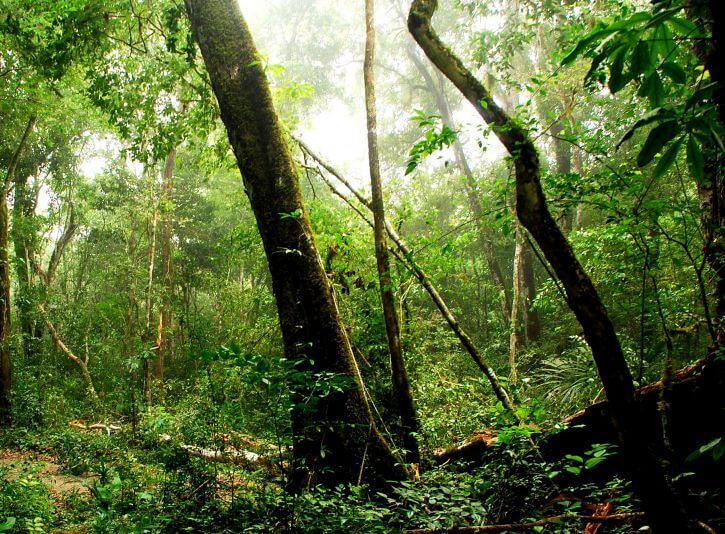
The forest's scale is matched by the complexity of its ecological relationships, functioning as an integrated system in which every element, from towering emergent ceiba trees (Ceiba pentandra), which can reach heights of 60 m (197 ft), to the microscopic fungi decomposing fallen leaves, plays a role in maintaining the whole. Its vertical structure creates multiple layers stacked one atop another: an emergent layer of massive hardwoods like mahogany (Swietenia macrophylla) and Spanish cedar (Cedrela odorata) forms a canopy dense enough to be walked upon in places, functioning as an aerial highway for countless arboreal species, while a secondary layer of smaller trees creates a three-dimensional matrix of branches, vines, and epiphytes that multiplies available habitat many times over.
Descending toward the forest floor, the understory becomes a twilight world where specialized plants have evolved to capture the mere 2-5% of sunlight that penetrates the layers above, while strangler figs begin decades-long journeys toward the canopy, eventually becoming some of the forest's most impressive individual trees. The forest floor itself is a site of constant decomposition and renewal, with insects, fungi, and bacteria breaking down the steady rain of organic matter from above and recycling nutrients with remarkable efficiency. This efficiency allows the forest to maintain its productivity despite growing on soils that, in conventional agricultural terms, are often quite poor.
A Symphony of Biodiversity
Within this architectural framework, the Maya Forest supports one of the most diverse biological communities on Earth, harboring over 2,800 species of vascular plants, a botanical diversity rivaling much larger Amazonian forests. Many species here remain scientifically undescribed, suggesting the forest's biological wealth may be even greater than currently recognized.
The forest's mammalian fauna includes several of the Neotropics' most significant species. The jaguar (Panthera onca), the largest cat in the Americas, moves through these forests as both apex predator and ecosystem engineer; recent research has revealed that Maya Forest jaguars represent genetically distinct populations serving as crucial links between Central and South American jaguar populations, making their conservation here important for the species' long-term survival throughout its range. The puma (Puma concolor) occupies similar habitats while avoiding direct competition through subtle differences in prey preference and activity patterns, and both species function as umbrella species whose conservation automatically protects vast areas of habitat benefiting countless other organisms.
The forest canopy comes alive with the scarlet macaw (Ara macao), whose Maya Forest populations represent some of the last viable breeding communities of the endangered northern subspecies (A. m. cyanoptera). These birds require large territories and specific old-growth nesting sites, making them reliable indicators of forest health. Troops of Guatemalan black howler monkeys (Alouatta pigra) contribute their own acoustic signature to the forest: territorial calls, amplified by specialized throat structures, audible up to 5 km (3 mi) away, forming a dawn and dusk chorus that has echoed through these forests for millions of years, and which also serve as important seed dispersers whose feeding habits help maintain the genetic diversity and spatial distribution of forest plants. On the forest floor, herds of white-lipped peccaries (Tayassu pecari), sometimes numbering in the hundreds, act as the forest's primary soil engineers, their rooting behavior creating microhabitats that benefit countless other species while cycling nutrients through the ecosystem.
The forest's smallest inhabitants contribute their own diversity: the canopy alone is estimated to support 40,000 insect species, many specialized for life in this three-dimensional aerial environment, including brilliant blue Morpho butterflies and leafcutter ants (Atta spp.), whose underground fungus gardens represent some of the most sophisticated agricultural systems found anywhere in nature.
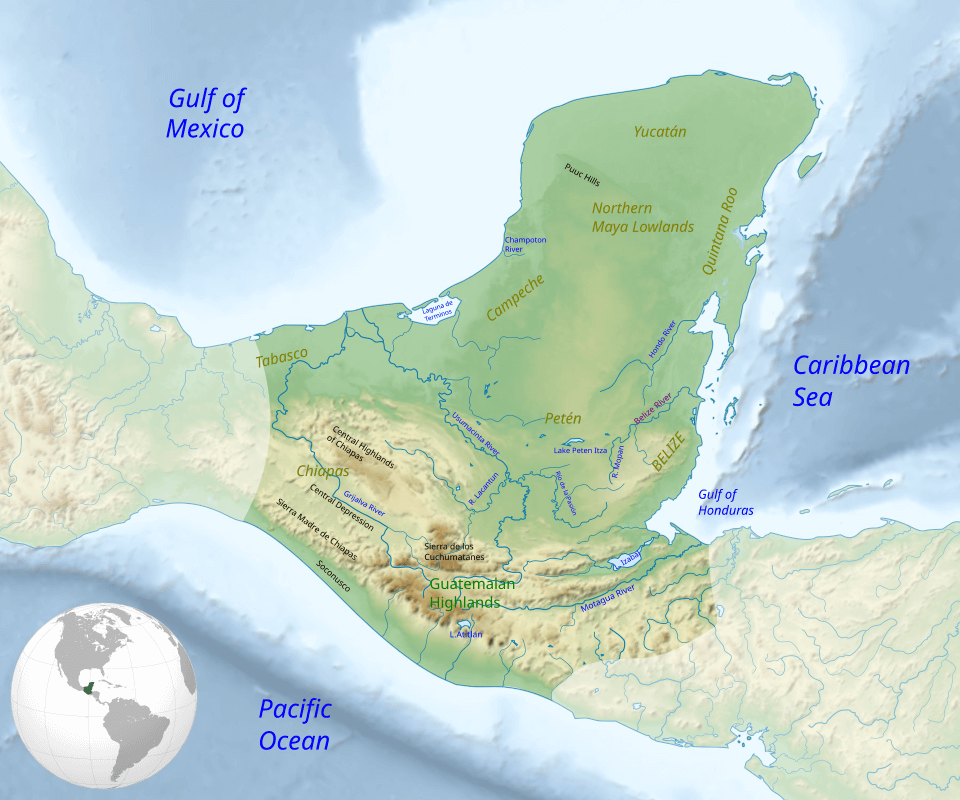
Map of the Maya region, with major rivers, mountain ranges, and regions.
Archaeological Landscapes: Cities in the Forest
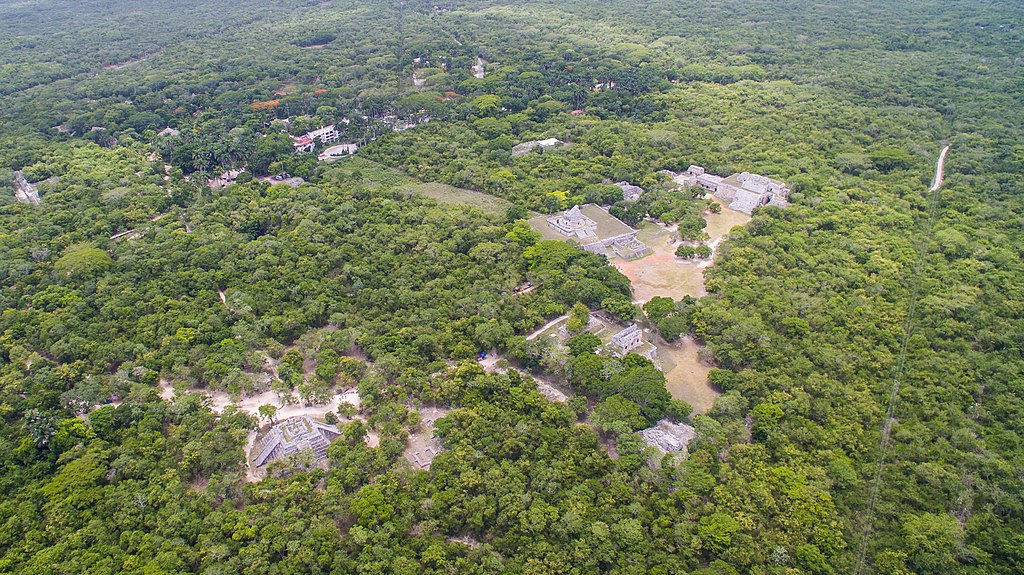
What makes the Maya Forest distinctive among the world's great wilderness areas is how thoroughly it has integrated human history into its ecological fabric. Rather than standing as isolated monuments to a vanished civilization, its archaeological sites remain dynamically connected to their natural surroundings: temples and palaces emerge from the landscape rather than dominating it, their limestone blocks slowly reclaimed by strangler figs and tropical vines in a process that blurs the line between natural and cultural heritage.
Tikal National Park, encompassing 575 sq km (222 sq mi) of rainforest, exemplifies this integration. Visitors can climb ancient pyramids rising to 65 m (213 ft) above the forest floor, their summits offering views across an unbroken canopy stretching to the horizon, and the archaeological importance of these structures cannot be separated from their ecological role: the pyramids function as artificial emergent trees, creating unique microclimates and providing nesting sites for raptors and other canopy species.
The Yaxhá-Nakum-Naranjo Cultural Triangle offers another example of this archaeological-ecological integration, protecting not only three major Maya cities but also the watersheds, forest corridors, and habitat connections that allow wildlife populations to move freely across the landscape, a management approach that treats cultural and natural heritage as inseparable elements of a single system.
Mexico's Calakmul Biosphere Reserve, designated as both a UNESCO World Heritage Site and a UNESCO Biosphere Reserve, extends this integration further still. The reserve protects one of the Maya world's largest ancient cities alongside 723,185 hectares (1.8 million acres) of the most intact tropical rainforest remaining in Mexico, and researchers studying ancient Maya agricultural systems there work alongside biologists investigating jaguar ecology, their findings mutually reinforcing our understanding of how human societies can coexist sustainably with complex natural systems.
Three Biosphere Reserves, and a New Trinational Corridor
The Maya Forest's conservation depends critically on three major protected areas that together form the backbone of regional ecosystem protection, each reflecting a different national approach to balancing conservation with sustainable development while sharing the recognition that effective conservation must integrate ecological, cultural, and social dimensions together.
Guatemala's Maya Biosphere Reserve, established in 1990, covers 2.1 million hectares (5.2 million acres), nearly one-fifth of the country's total territory. The reserve employs a zoning system of strictly protected core areas, sustainably managed buffer zones, and multiple-use areas where local communities can engage in forest-friendly economic activities, protecting not only biodiversity but also the traditional knowledge and practices of contemporary Maya communities whose ancestors built the great cities that dot the landscape.
Mexico's Calakmul Biosphere Reserve, at 723,185 hectares (1.8 million acres), protects the headwaters of numerous river systems while serving as a crucial habitat corridor connecting forest fragments across the Yucatán Peninsula; recent expansion of the protected area has strengthened these connections, creating opportunities for large mammals such as jaguars to maintain genetic exchange across their range.
The Montes Azules Biosphere Reserve in Chiapas adds another 331,200 hectares (818,394 acres), protecting the upper watersheds of rivers flowing ultimately into both the Gulf of Mexico and the Caribbean Sea. This reserve encompasses some of Mexico's most pristine cloud forests, with elevational gradients that support species assemblages found nowhere else in the Maya Forest system.
Together, these three biosphere reserves have long formed a conservation network protecting over 3.2 million hectares (7.9 million acres) of critical habitat. In August 2025, Mexico, Guatemala, and Belize took this cooperation a significant step further, signing an agreement to establish the Biocultural Corridor of the Great Maya Forest, a new trinational initiative spanning 5.7 million hectares that formally links Calakmul with Guatemala's Mirador-Río Azul National Park and a network of Belizean reserves, including Río Bravo, Aguas Turbias, Shipstern, Crooked Tree, and Cockscomb Basin. The corridor is intended to allow wildlife, jaguars especially, to move freely across all three countries' portions of the forest for the first time under a single coordinated framework, representing the most ambitious conservation commitment the Maya Forest has seen to date.
Contemporary Challenges and Community Solutions
Despite its protected status and international recognition, the Maya Forest faces significant contemporary challenges: expanding agricultural frontiers, growing demand for tropical hardwoods, increasing tourism pressure, and climate change impacts that are altering precipitation patterns and increasing the frequency of severe storms.
Deforestation remains the greatest threat to the forest's integrity. Satellite monitoring shows the Maya Forest has lost approximately 25% of its original extent over the past several decades, with clearing rates fluctuating in response to economic incentives, enforcement capacity, and political stability. The loss is particularly severe along the forest's edges, where conversion to cattle ranching and large-scale agriculture creates fragmentation that can disrupt ecological processes even in areas that remain forested.
Within this challenging context, community-based conservation initiatives are demonstrating that alternatives to destructive land use can provide both conservation benefits and economic opportunities. Forest concessions in Guatemala's Maya Biosphere Reserve allow local communities to harvest timber, chicle latex, and non-timber forest products under strict sustainability guidelines, generating significant income while maintaining forest cover and supporting wildlife populations. Community-managed tourism initiatives create similar incentives, as Maya communities that once relied primarily on subsistence agriculture develop expertise in hospitality, guiding, and artisan production, building diversified local economies that depend on maintaining healthy forest ecosystems.
The harvesting of chicle, the latex of the sapodilla tree (Manilkara zapota), represents a traditional practice that has found renewed relevance in contemporary conservation. Chicle harvesters, known as chicleros, maintain intimate knowledge of forest ecology while providing a sustainable source of natural latex for specialty products, and their work requires maintaining large areas of intact forest, creating a direct economic incentive for conservation.
Climate Change and Forest Resilience
Research has shown the Maya Forest plays a significant role in regional climate regulation, generating approximately 75% of its own rainfall through evapotranspiration from its vast leaf surfaces. This self-sustaining hydrological cycle makes the forest resilient to moderate climate variation, but also means large-scale deforestation could trigger irreversible changes in regional precipitation patterns.
Climate change projections for the region point to rising temperatures, more variable precipitation, and stronger tropical storms, all of which could stress forest ecosystems in unprecedented ways. The forest's extraordinary diversity may represent its greatest asset in adapting to these changes, since multiple species occupying similar ecological roles provide redundancy that can maintain ecosystem functions even where individual species face local extinction. Conservation scientists increasingly recognize that protecting the Maya Forest requires thinking beyond traditional park boundaries to consider the broader landscape matrix in which protected areas sit, an approach reflected in the payment-for-ecosystem-services programs and sustainable certification systems that have grown alongside the region's protected-area network in recent years.
Conclusion
The Petén Basin and Maya Forest represent far more than a collection of protected areas and archaeological sites; they embody a model of human-nature coexistence that grows more relevant as the twenty-first century's environmental pressures intensify. Here, ancient cities remain integrated with living forests, traditional knowledge combines with modern science, and conservation success depends directly on the prosperity of local communities. The 2025 trinational corridor agreement suggests that this model is, if anything, gaining momentum rather than losing it. Protecting this landscape, from Tikal's temples to Calakmul's forest canopy, means protecting an irreplaceable natural heritage and a living record of humanity's capacity to coexist with the wilderness that sustains it.